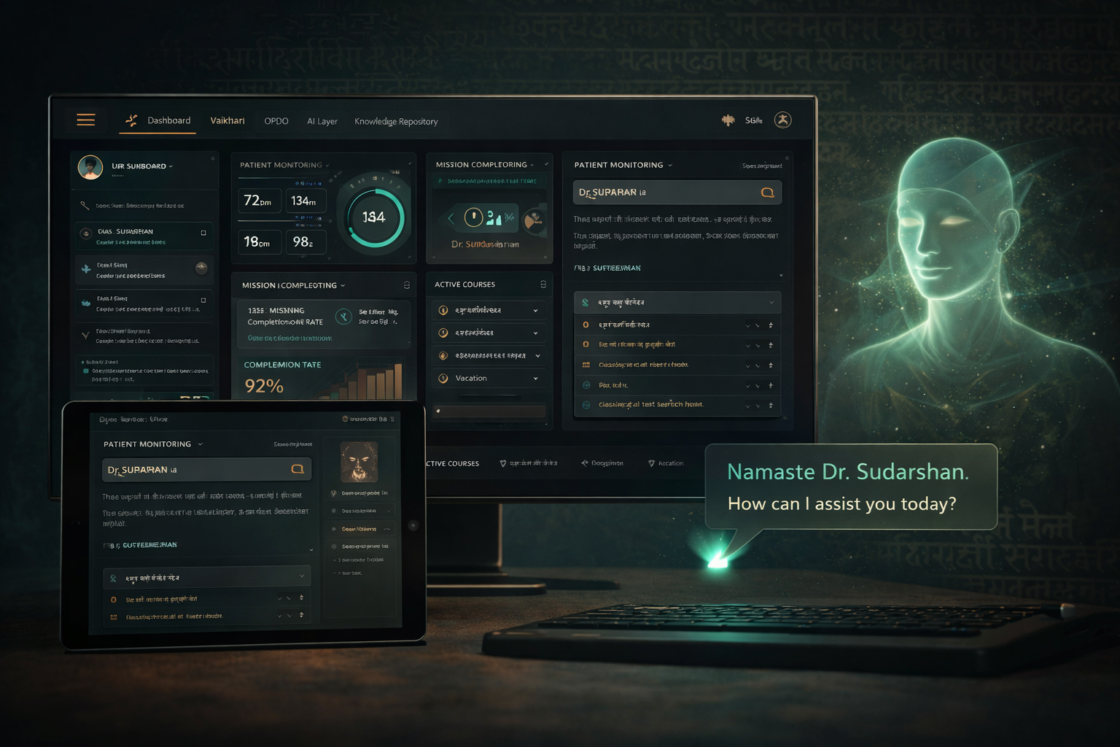
Ayurveda today does not merely need digitization. It needs intelligent preservation, contextual interpretation, and authenticated transmission. That is where artificial intelligence becomes deeply relevant. But the moment we state “AI for Ayurveda,” a second, more formidable truth appears immediately: Ayurveda is not an effortless knowledge system to computationally capture. Authenticated Ayurveda AI is far more difficult than building a normal conversational chatbot or a generic large medical language model.
This case study evaluates the possibility, necessity, and architectural requirements of integrating computational intelligence into traditional Indian medicine. It is structured around a central, unavoidable tension: Ayurveda urgently needs artificial intelligence to survive the digital fragmentation of the modern era, but authentic Ayurveda is one of the most difficult domains in which to build trustworthy, reliable, and epistemically safe AI.
To systematically analyze this technological frontier, this report is presented in three core movements. First, it examines why artificial intelligence is practically needed to alleviate the current friction in Ayurvedic knowledge dissemination and clinical practice. Second, it demonstrates why ordinary, statistically driven AI fails to capture the epistemic authenticity of the science. Third, it extensively details why engineering an authenticated Ayurveda AI is a profound, multi-layered research challenge rather than a simple software development project.
Why Ayurveda Needs AI
The necessity of artificial intelligence for Ayurveda arises directly from the present structural condition of the field. Ayurveda possesses enormous textual depth, extensive clinical breadth, highly diverse regional traditions, paramparā-based (lineage-based) interpretations, immense formulation diversity, and intensely context-sensitive clinical applications. Yet, despite this profound richness, the contemporary practitioner, student, researcher, and patient often face severe fragmentation. Knowledge is heavily scattered across classical Samhitās, complex commentaries, specialized nighaṇṭus (lexicons), regional clinical practices, unpublished physician notes, localized classroom teaching, and living oral traditions. A senior physician may intuitively know the science, but manual retrieval during a consultation is prohibitively slow. A student may possess digitized books, but lacks the interpretive bridge required to apply them. A researcher may uncover isolated textual references, but fail to identify the contextual thread connecting them across centuries of medical evolution. Artificial intelligence, if engineered properly, has the unprecedented capacity to reduce this friction. It can facilitate structured retrieval, comparative textual navigation, clinical pattern support, dynamic formulation mapping, educational assistance, language bridging, and the preservation of difficult, tacit knowledge that otherwise remains inaccessible.
The Vastness and Layered Complexity of Ayurvedic Navigation
Ayurveda is inherently vast, structurally layered, and exceptionally difficult to navigate quickly under modern clinical working conditions. The foundational literature consists of the Brihattrayi (Charaka Samhita, Sushruta Samhita, and Ashtanga Hridaya) and the Laghutrayi, supplemented by dozens of specialized treatises. During an active clinical encounter, a physician cannot manually search through dozens of granthas (books), exhaustive commentaries, and parallel references to validate every practical decision. Artificial intelligence architectures, specifically those utilizing domain-specific knowledge graphs and optimized retrieval mechanisms, can exponentially increase retrieval speed. By structurally linking symptoms, doshic imbalances, and classical references, AI ensures that clinical decisions are informed by the totality of the available literature rather than merely what the practitioner can recall from memory in a ten-minute window.
Unifying Highly Distributed Knowledge Sources
Ayurveda knowledge is highly distributed across disparate mediums. It exists simultaneously in dense classical Sanskrit verses, elaborate commentarial prose, regional manuscripts etched on palm leaves, modern teaching notes, printed contemporary books, and the living oral paramparā of master physicians. Previous governmental and institutional initiatives, such as the Traditional Knowledge Digital Library (TKDL) and the Ayush Grid, have made commendable strides in digitizing Ayurvedic formulations across international languages to prevent biopiracy and support digital access. However, this data often remains siloed. Artificial intelligence can help unify access across these scattered sources, creating a centralized, interoperable computational network where a query regarding a specific herb retrieves its classical Sanskrit definition, its commentarial interpretation, its regional uses, and its modern pharmacological validation simultaneously.
Bridging the Gap Between Textual Knowledge and Usable Application
There exists a profound gap between theoretical textual knowledge and usable clinical application in contemporary Ayurvedic education and practice. Many students can fluently read and recite a classical Sanskrit verse but remain entirely unable to connect its underlying principles to practical clinical variables such as dravya (substance), doṣa (bio-energetic principle), avasthā (stage of disease), deśa (habitat/region), kāla (time/season), anupāna (vehicle of administration), rogibala (patient strength), or chikitsākrama (line of treatment). Artificial intelligence can potentially serve as a highly dynamic interpretive assistant. By utilizing computational algorithms that map these variables together, an AI system can bridge theoretical definitions with multidimensional clinical realities, helping the practitioner visualize how a static verse translates into a dynamic treatment protocol.
Converting Static Knowledge into Interactive Systems
A large proportion of authentic Ayurvedic knowledge is currently underused simply because it is not searchable in a structured, computational form. While PDFs and scanned manuscripts exist, they are computationally inert. Artificial intelligence, particularly through the deployment of ontological mapping and entity extraction, can convert this static knowledge into interactive knowledge systems. Platforms like the GRAYU database demonstrate this potential by integrating over 12,000 medicinal plants, 1,000 formulations, 130,000 phytochemicals, and 13,000 diseases into a unified meta-graph framework. When knowledge becomes interactive, researchers can perform multi-step, filtered queries—tracing connections from a specific indigenous plant to its constituent phytochemicals, and subsequently to its associated classical formulations and modern disease indications.
Alleviating Memory Burden and Contextual Confusion
Ayurveda education currently suffers from an immense memory burden and frequent contextual confusion. Students are required to internalize vast lexicons of herbs, properties, and disease classifications, often losing sight of the underlying logical architecture of the science. Artificial intelligence can help students dynamically trace the sambandha (relationships) between concepts rather than forcing them to merely memorize isolated definitions. By utilizing AI-driven semantic networks, a student querying the concept of Vata can immediately visualize its systemic relationship to specific dhatus (tissues), its aggravation during specific seasons, and its mitigation through targeted rasas (tastes), thereby fostering deep conceptual learning rather than rote memorization.
Standardizing Clinical Documentation and Workflow
Clinical documentation in Ayurveda is weakly standardized across many contemporary healthcare settings. The lack of structured electronic health records (EHR) tailored to traditional paradigms limits the ability to conduct large-scale retrospective studies or track longitudinal patient outcomes. Furthermore, attempting to force Ayurvedic clinical data into allopathic EHR models strips the data of its holistic nuances. AI can support structured case-taking, advanced pattern recognition, longitudinal comparison, and knowledge-linked clinical workflows. Technologies such as Natural Language Processing (NLP) and Automatic Speech Recognition (ASR) can extract classical parameters directly from patient narratives, automatically generating SOAP (Subjective, Objective, Assessment, Plan) notes that perfectly align with Ayurvedic diagnostic parameters.
Overcoming the Language Barrier
Language remains a formidable barrier to the widespread dissemination and clinical application of authentic Ayurvedic principles. A vast amount of critical Ayurvedic wisdom remains locked in dense classical Sanskrit, mixed Sanskrit-regional terminology, or antiquated technical vocabularies that modern practitioners struggle to decode. Artificial intelligence, if trained responsibly with deep bilingual or multilingual capabilities, can help bridge Sanskrit with English, Hindi, Kannada, Malayalam, and other regional languages. Domain-specialized language models, such as AyurParam, have demonstrated the ability to process reasoning and objective-style questions in both English and Hindi, minimizing the performance gap across languages and making classical knowledge accessible to a broader demographic without losing semantic fidelity.
Ensuring Practical Accessibility in a Digital World
Patients increasingly live in a fast, interconnected, digital world. They demand immediate access to healthcare insights, personalized wellness tracking, and remote consultations. If Ayurveda does not create intelligent, secure, and accurate digital interfaces, its practical accessibility will inevitably decline, even if its underlying wisdom remains entirely intact. AI-driven platforms, virtual health assistants, and remote triage systems powered by predictive analytics are essential for ensuring that Ayurvedic care remains a viable, integrated option within modern pluralistic healthcare ecosystems.
Why Simple AI Is Not Enough
This is where the technological proposition becomes highly complex. The fundamental problem is not building “an Ayurveda chatbot.” The problem is that most modern AI systems are prediction machines built on patterns of language, not guardians of epistemic authenticity. Ayurveda cannot be computationally reduced to the surface similarity of words or the probabilistic generation of text tokens.
Most modern AI systems generate responses based on statistical likelihood, not on pramāṇa (valid means of knowledge), sampradāya (authentic tradition), or clinical accountability. This is inherently dangerous in the context of Ayurveda because a highly plausible, eloquently articulated answer generated by an LLM can still be categorically wrong in principle, wrong in its contextual interpretation, wrong in its indicated usage, or critically wrong in its clinical application. General-purpose models lack true understanding of the underlying medical concepts, rendering them unsafe for handling complex patient cases or rare diseases where deep contextual comprehension is paramount.
Ayurveda is not just health information. It is structured knowledge deeply embedded in ontology, methodology, interpretive discipline, and cultural context. An AI that merely summarizes translated verses without an algorithmic understanding of prakaraṇa (contextual relevance) will inevitably distort the teaching. Furthermore, standard AI architectures like Retrieval-Augmented Generation (RAG)—while useful for mitigating hallucinations in corporate databases—are highly limited when applied to complex traditional medicine. RAG systems struggle with the structural aggregation of precise numerical data, suffer from context collapse when querying layered philosophical texts, and frequently lack the rigor required to trace consistent clinical guidelines without introducing retrieval noise. When standard AI encounters traditional medicine, it flattens the science, replacing deep clinical reasoning with generic, homogenized wellness advice.
Why Authenticated Ayurveda AI Is Not Easy
This epistemic friction brings us to the heart of the research challenge. Building authenticated, culturally safe, and clinically reliable AI for Ayurveda requires navigating a labyrinth of linguistic, ontological, and clinical complexities. This undertaking is not simple; it can be broken down into fifteen deep, structural challenges that must be overcome by computational architects.
First, Ayurveda is context-driven, not keyword-driven. The exact meaning of a technical term mutates depending on the specific chapter, tantra (treatise), sthāna (section), disease context, therapeutic stage, the specific commentator analyzing the verse, and the intended clinical application. One word does not always carry one stable meaning across the corpus. For example, a term used in a surgical context in the Sushruta Samhita may have a vastly different implication when used in an internal medicine context in the Charaka Samhita. AI systems and basic semantic search engines are usually exceptionally weak in this kind of layered contextual reading unless their ontologies are specifically designed to handle polyvalency and situational disambiguation.
Second, Ayurveda is not a single book tradition. It is a vast civilizational knowledge network. Foundational works like Charaka, Sushruta, Ashtanga Hridaya, Kashyapa, Bhela, and Harita, supplemented by extensive nighaṇṭus (pharmacopoeias), ṭīkās (commentaries), regional prayogas (practical manuals), rasa texts (alchemy), tantra texts, and the empirical knowledge of living oral physician lineages all contribute to the ecosystem. An AI must not only ingest and read these texts but also algorithmically distinguish between levels of authority, textual genres, clinical scopes, chronologies, and usage contexts to avoid conflating disparate medical paradigms.
Third, Sanskrit itself is a major computational difficulty. Classical medical Sanskrit is intensely dense, compact, polyvalent, and frequently elliptical. The same sentence may require profound grammatical unpacking, doctrinal awareness, and commentarial support to be accurately translated. Complex linguistic phenomena such as sandhi (euphonic junctions where words blend at boundaries), samāsa (long, multi-word compounds), lakṣaṇā (implied meaning), vyañjanā (suggestive meaning), dense technical vocabulary, and śāstric brevity all make machine interpretation exceptionally difficult. Advanced models like the Double Decoder RNN (DD-RNN) achieve high accuracy in locating sandhi splits (95%) but still struggle to accurately predict the constituent words without human correction. A general language model will often sound entirely confident while fundamentally misunderstanding the grammatical structure of the actual Sanskrit text.
Fourth, Ayurveda uses relational thinking rather than isolated facts. It is not enough to know what vāta is, or what guggulu is, or what agni is. The entire medical framework is predicated on dynamic interdependencies: doṣa–dūṣya (pathogen-tissue interaction), agni–āma (metabolic fire vs. metabolic toxin), srotas–lakṣaṇa (channel pathology), kāla–avasthā (time and disease stage), dravya–guṇa–karma (substance-property-action), and yukti-based therapeutic judgment. AI must utilize advanced knowledge graphs to model this interdependence, not mere fact storage. Initiatives like the GRAYU database demonstrate this necessity by defining precise meta-graph relationships—such as Phytochemicals Plants and Plants Diseases—to ensure consistent processing.
Fifth, clinical application in Ayurveda is radically individualized. The same biomedical disease name (e.g., Rheumatoid Arthritis) does not lead to the same treatment protocol in every patient. Treatment logic is constantly altered by an extensive matrix of patient-specific variables, including deha-prakṛti (physical constitution), vikṛti (current imbalance), bala (strength), satva (mental state), satmya (adaptability), āhāra (diet), āyu (age), deśa (geography), ṛtu (season), stage of disease, associated doṣas, and previous interventions. A generic AI response to a symptom query can easily become misleading because Ayurveda is inherently person-specific. Advanced AI systems, such as the AyurVAID D-RISK model, attempt to capture this by analyzing over 40 non-invasive features—including classical prodromal indicators of Prameha—using AutoML frameworks to detect non-linear metabolic imbalances, a task basic LLMs cannot perform natively.
Sixth, textual contradiction is often only apparent, not real. Different Ayurvedic texts frequently appear to disagree, but the difference may be due to the clinical context, the level of intervention, the stage of the disease, specific indications, or the unique philosophical lens of the commentator. For example, commentators like Chakrapanidatta utilized classical logical principles, such as Utsarga–Apavada Nyaya (the principle of general rules and specific exceptions), to seamlessly reconcile apparent contradictions between the Charaka Samhita and the Sushruta Samhita. AI must be engineered to computationally replicate this reconciliation process, applying context-specific rules rather than flattening the texts into a state of algorithmic confusion or false uniformity.
Seventh, many authentic practices are preserved entirely within living traditions, not fully documented in digitized text. A vast repository of clinical acumen is held within family lineages (paramparā). If an AI model is trained only on publicly available, superficial, or widely translated content, it will inevitably represent a reduced, homogenized, and frequently distorted version of Ayurveda. Capturing this tacit knowledge requires the development of human-in-the-loop (HITL) systems where senior Vaidyas continuously validate the model’s outputs based on empirical clinical success.
Eighth, source quality is a severe problem. The contemporary internet is saturated with a massive amount of digital Ayurveda content that is inaccurate, highly commercialized, oversimplified, or contaminated with modern assumptions entirely disconnected from classical textual discipline. If an AI model indiscriminately scrapes and learns from these contaminated datasets, it ceases to be a tool for knowledge retrieval and instead becomes a high-speed amplifier of medical confusion and misinformation.
Ninth, authentication itself is a multi-layer challenge. What specific parameters define “authenticated Ayurveda”? Is it restricted only to the mūla (primary) text? Does it encompass the ṭīkā (commentary)? Does it include sampradāya-based applied interpretation? Does it validate modern physician-tested prayoga? Does it include regional pharmacological lineages? An AI project must architect a rigid, definable hierarchy of epistemic authority. Without a transparent, programmable hierarchy, the term “authenticated” devolves into a mere decorative word devoid of academic or clinical rigor.
Tenth, translation is not enough. A vast array of highly technical Ayurvedic terms cannot be safely translated into single-word English equivalents without catastrophic semantic loss. Words such as agni (the multi-systemic mechanism of biological transformation), ojas (the refined essence dictating systemic resilience), āma (unmetabolized, immunogenic metabolic byproducts), srotas (complex macro and micro-transport systems), śukra, meda, grahaṇī, or manas cannot be flattened into Western biomedical equivalents. AI must utilize knowledge graphs to preserve this source terminology while explaining its multidimensional meaning faithfully.
Eleventh, Ayurveda includes non-linear reasoning. Yukti (conjunctive reasoning) is not a linear diagnostic checklist. It is trained, dynamic intelligence operating upon multiple, simultaneous variables to arrive at a highly individualized clinical judgment. Interestingly, computational linguists are discovering that ancient hermeneutic methodologies like Tantrayukti—a systematic methodology for interpreting complex scientific texts—closely mirror the “Self-Attention” mechanisms used in modern Large Language Models. Just as attention layers process context and infer relationships, interpretational yuktis operate at the semantic level. However, reproducing yukti computationally for real-time diagnostic synthesis is orders of magnitude much harder than merely retrieving a static classical verse.
Twelfth, there is a profound legal and ethical challenge. If an AI gives direct clinical advice without sufficient technological safeguards, source traceability, uncertainty handling, and strict practitioner oversight, it becomes legally and medically unsafe. The ICMR’s “Ethical Guidelines for Application of Artificial Intelligence in Biomedical Research and Healthcare” explicitly mandate that human autonomy must not be undermined by algorithms. In Ayurveda, where medical interventions depend entirely on nuanced, multi-variable examination and correct contextual judgment, the deployment of unsupervised diagnostic AI presents an unacceptable level of malpractice liability and ethical risk.
Thirteenth, Ayurveda is not only medicine in the narrow biomedical sense. It is a comprehensive life science encompassing dravya (pharmacology), āhāra (dietetics), vihāra (lifestyle), rasāyana (rejuvenation), preventive frameworks, embryology, psychology, philosophy, seasonal code (rtucharya), ritual intersections, and broader cultural knowledge. Building AI for Ayurveda means clearly deciding and defining the computational boundaries of the system itself. Decoupling these elements strips Ayurveda of its holistic efficacy, yet integrating them computationally defies standard biomedical modeling.
Fourteenth, even OCR and physical digitization are highly difficult. Before an AI system can begin semantic interpretation, it must overcome severe optical character recognition hurdles. The primary data sources include old books, decaying manuscripts, complex variations in Devanagari print, and diverse regional scripts (Grantha, Telugu, Malayalam, Kannada). Damaged pages, fading ink, non-standardized typographical conventions, and inconsistent historical editions create massive amounts of noise that must be cleaned before AI interpretation even begins.
Fifteenth, citation and traceability are absolutely essential. In an authenticated Ayurveda AI, every major clinical claim or generated answer should ideally be explicitly traceable to its exact source text, commentary, physical edition, and interpretive basis. Without rigid source traceability, an AI model may sound highly impressive to a layperson while remaining academically bankrupt and clinically useless. To mitigate risks associated with hallucinations, systems must implement rigorous data provenance architectures and tamper-evident audit logs to record system inputs and link generated recommendations to peer-reviewed sources.
This extensive list of challenges gives rise to a powerful contrast line that defines the core thesis of this case study:
General AI can answer.
Authenticated Ayurveda AI must answer, justify, trace, qualify, and remain faithful to context.
What Makes an Ayurveda AI Truly Authenticated
To overcome these formidable challenges, it must be recognized that authentication is not just about data upload. It fundamentally needs architecture. An AI system cannot be considered an authentic representation of Ayurveda unless it adheres to strict structural mandates.
| Architectural Mandate | Functional Requirement for Ayurveda AI |
| Source Hierarchy | It should maintain a programmable hierarchy: primary texts, commentaries, cross-references, validated modern annotations, and clearly marked practitioner insights. |
| Linguistic Preservation | It should process and preserve classical Sanskrit terminology, strictly avoiding the over-translation of polyvalent concepts into reductive English equivalents. |
| Provenance | It should provide citation-backed responses, ensuring end-to-end traceability for every clinical claim. |
| Epistemic Distinction | It should explicitly distinguish between a direct textual statement, an inferred algorithmic conclusion, a historical commentator’s interpretation, and a contemporary practical tradition. |
| Safety Guardrails | It should be programmed to recognize and declare its own uncertainty, strictly avoiding the confident “false certainty” (hallucinations) characteristic of generic LLMs. |
| Algorithmic Design | It should be natively designed for contextual, multi-variable querying (e.g., generating ranked lists based on Rasa, Guna, Virya, Vipaka) rather than simple linear word matching. |
| Validation | It should integrate continuous human expert review, relying on the combined oversight of experienced clinical Vaidyas and traditional Sanskrit scholars (HITL). |
| Ontological Depth | It should allow multiple interpretive layers rather than flattening the science and pretending there is always one simplistic, universal answer. |
| Functional Separation | It should structurally separate educational use, academic research use, and active clinical support use, because all three domains require vastly different levels of legal and computational caution. |
| Reconciliation Logic | It should be able to handle apparent textual contradiction through contextual resolution and logical principles like Utsarga–Apavada Nyaya. |
| Practitioner Sovereignty | It should never erase the role of the physician, guru, or scholar. Its architectural mandate must be to assist and augment, not replace the human exercise of Yukti. |
The Problem-Solution-Risk Model
To synthesize the current state of Ayurvedic computational integration, the landscape can be viewed through a tripartite Problem-Solution-Risk model:
- Problem: Ayurvedic knowledge is phenomenally vast and clinically potent, yet it remains functionally fragmented, difficult for modern practitioners to rapidly access, and is often severely misrepresented or mistranslated in the digital ecosystem.
- Opportunity: Artificial intelligence offers the unprecedented capability to make this civilizational knowledge deeply searchable, pedagogically teachable, contextually relatable, and globally scalable without losing its foundational principles.
- Risk: If these systems are built casually—relying on standard LLM statistical likelihoods without ontological grounding and expert verification—the AI will inadvertently spread polished, highly convincing misinformation faster than sheer human ignorance ever could.
- Conclusion: Therefore, only authenticated, source-grounded, context-aware Ayurveda AI is worth building. Any lesser technological compromise poses an existential threat to the integrity of the medical system.
Why This Is a Research Problem, Not Just a Software Project
The sheer magnitude of these epistemic and computational hurdles dictates that building an authenticated Ayurveda AI requires deep, interdisciplinary collaboration between traditional Sanskrit scholars, clinical Vaidyas, data architects, ontology designers, NLP engineers, computational biologists, UX designers, and legal and clinical reviewers.
This is not a simple content-entry project or a standard software development lifecycle. It is a long-term, multi-decade knowledge-engineering problem. Attempting to build comprehensive AI models for traditional medicine without specialized scoping frequently leads to project failure. The necessity for domain specialization is clearly demonstrated by recent advancements in targeted model training. For example, the development of AyurParam-2.9B, a specialized bilingual language model fine-tuned on an expertly curated Ayurveda dataset, proves that smaller, highly specialized models vastly outperform massive, generalized LLMs (such as Llama-3.1-8B or Gemma-2-27B) in traditional medicine tasks. As the data illustrates, throwing massive computational power at Ayurvedic texts does not solve the problem of contextual understanding. Only rigorous domain adaptation, high-quality expert supervision, and precise ontological framing can yield AI that is culturally congruent and clinically reliable.
Ayurveda does not merely need artificial intelligence. It needs disciplined intelligence shaped by authenticity. Without that, AI may make Ayurveda look more available while actually making it less reliable. The ultimate challenge for computational linguists, knowledge engineers, and medical scholars is not to make Ayurveda sound modern. The challenge is to make its living intelligence computationally accessible without damaging its structure, its pramāṇa, or its soul.