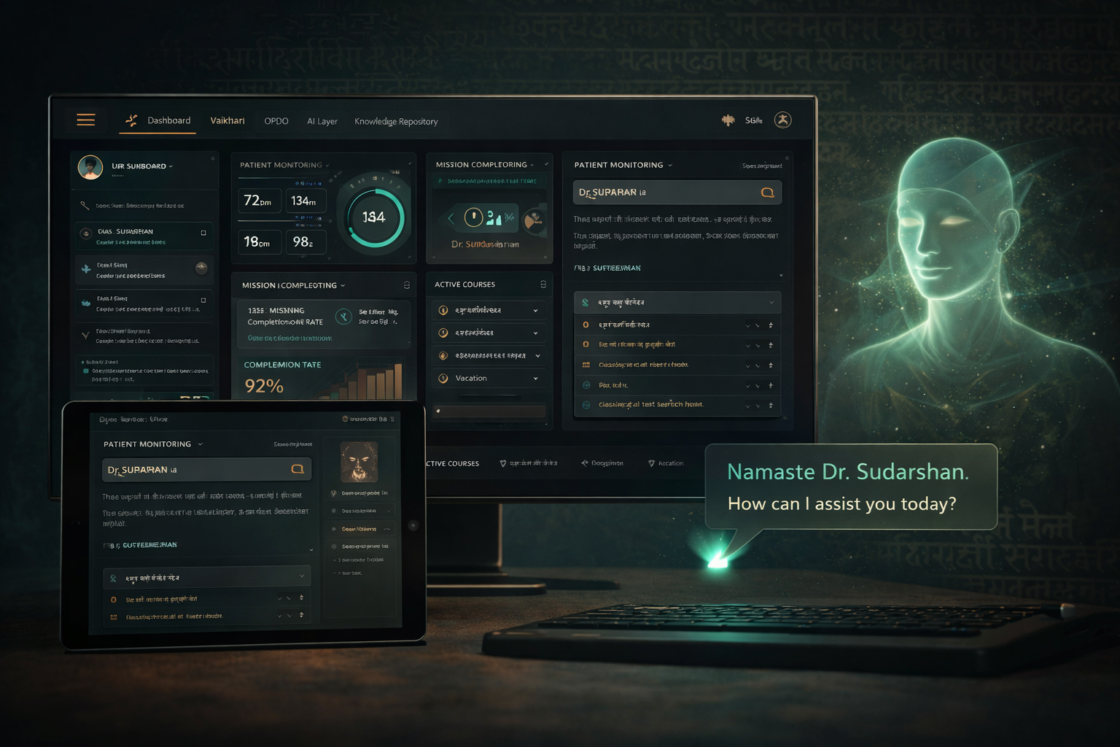

The contemporary integration of Artificial Intelligence (AI) into Ayurveda represents a profound epistemological, clinical, and technological frontier. The discipline of Ayurveda requires far more than rudimentary digitization or the superficial mapping of ancient texts into modern databases. It demands intelligent preservation, contextual interpretation, and authenticated transmission. As global health paradigms shift increasingly toward integrative, precision-based medicine, the necessity of utilizing advanced computational models to preserve and operationalize traditional knowledge has never been more acute. The World Health Organization (WHO) has formally acknowledged these efforts through its technical brief, “Mapping the Application of Artificial Intelligence in Traditional Medicine,” which recognizes the pioneering initiatives undertaken to integrate AI with Ayush systems. This global recognition aligns with broader national visions, emphasizing “AI for all” and the strategic deployment of technology for inclusive social development.
However, the moment the phrase “AI for Ayurveda” is introduced, a formidable structural reality emerges: Ayurveda is not an easy knowledge system to computationally capture. The development of an authenticated Ayurveda AI is orders of magnitude more difficult than engineering a standard conversational chatbot or a generic biomedical Large Language Model (LLM). This case study and research report evaluates the possibility, necessity, and exact architectural requirements of integrating computational intelligence into traditional Indian medicine, with a specific focus on deploying dedicated AI hardware devices within educational colleges and clinician networks in geographically complex regions such as Chak Bhalwal, Jammu and Kashmir.
The analysis is structured around a central, unavoidable tension. On one hand, Ayurveda urgently needs artificial intelligence to survive the digital fragmentation of the modern era, alleviate the cognitive burden on practitioners, and standardize clinical and educational workflows. On the other hand, authentic Ayurveda represents one of the most difficult epistemic domains in which to build trustworthy, reliable, and medically safe AI. General-purpose models operate on statistical likelihood rather than authentic tradition, clinical accountability, or the highly individualized clinical reasoning known as yukti. Consequently, when standard AI encounters traditional medicine, it flattens the science, replacing deep clinical reasoning with homogenized wellness advice that is epistemically unsafe.
This comprehensive report is presented in several core movements. It first examines the practical necessity of AI in alleviating the current friction in Ayurvedic knowledge dissemination. It subsequently deconstructs the fifteen structural challenges that render ordinary, statistically-driven AI inadequate for the task. The report then transitions into a rigorous market study and hardware analysis, establishing the empirical case for dedicated, edge-computing AI devices over cloud-dependent software. Finally, it provides an exhaustive use-case analysis for the deployment of these devices in Ayurveda educational institutions operating under the National Commission for Indian System of Medicine (NCISM) mandates, and within active clinician networks utilizing advanced diagnostic peripherals and electronic medical records.
The Structural Imperative: Why Ayurveda Needs Artificial Intelligence
The necessity of artificial intelligence for Ayurveda arises directly from the present structural condition of the field. The science possesses enormous textual depth, extensive clinical breadth, highly diverse regional traditions, paramparā-based (lineage-based) interpretations, immense formulation diversity, and intensely context-sensitive clinical applications. Yet, despite this profound richness, the contemporary practitioner, student, researcher, and patient often face severe fragmentation. Knowledge is heavily scattered across classical Samhitās, complex commentaries, specialized nighaṇṭus (lexicons), regional clinical practices, unpublished physician notes, localized classroom teaching, and living oral traditions.
The Vastness and Layered Complexity of Ayurvedic Navigation
Ayurveda is inherently vast, structurally layered, and exceptionally difficult to navigate rapidly under modern clinical working conditions. The foundational literature consists of the Brihattrayi (Charaka Samhita, Sushruta Samhita, and Ashtanga Hridaya) and the Laghutrayi, supplemented by dozens of specialized treatises. During an active clinical encounter, a physician cannot manually search through dozens of granthas (books), exhaustive commentaries, and parallel references to validate every practical decision. Artificial intelligence architectures, specifically those utilizing domain-specific knowledge graphs and optimized retrieval mechanisms, can exponentially increase retrieval speed. By structurally linking symptoms, doshic imbalances, and classical references, AI ensures that clinical decisions are informed by the totality of the available literature rather than merely what the practitioner can recall from memory in a ten-minute window.
Unifying Highly Distributed Knowledge Sources
Ayurvedic knowledge exists simultaneously in dense classical Sanskrit verses, elaborate commentarial prose, regional manuscripts etched on palm leaves, modern teaching notes, printed contemporary books, and the living oral paramparā of master physicians. Previous governmental and institutional initiatives, such as the Traditional Knowledge Digital Library (TKDL) and the Ayush Grid, have made commendable strides in digitizing Ayurvedic formulations across international languages to prevent biopiracy and support digital access. The Ayush Grid serves as a comprehensive IT backbone, creating platforms like the Ayush Hospital Management Information System (A-HMIS) and the NAMASTE portal for standardized terminologies. However, much of this data remains computationally siloed. AI can unify access across these scattered sources, creating a centralized, interoperable network where a query regarding a specific herb retrieves its classical Sanskrit definition, its commentarial interpretation, its regional uses, and its modern pharmacological validation simultaneously.
Bridging the Gap Between Textual Knowledge and Usable Application
A profound gap exists between theoretical textual knowledge and usable clinical application in contemporary Ayurvedic education. Many students can fluently recite a classical Sanskrit verse but remain entirely unable to connect its underlying principles to practical clinical variables such as dravya (substance), doṣa (bio-energetic principle), avasthā (stage of disease), deśa (habitat/region), kāla (time/season), anupāna (vehicle of administration), rogibala (patient strength), or chikitsākrama (line of treatment). Artificial intelligence serves as a highly dynamic interpretive assistant. By utilizing algorithms that map these variables together, an AI system bridges theoretical definitions with multidimensional clinical realities, helping the practitioner visualize how a static verse translates into a dynamic treatment protocol.
Converting Static Knowledge into Interactive Systems
A massive proportion of authentic Ayurvedic knowledge remains computationally inert. While PDFs and scanned manuscripts exist, they are not searchable in a structured manner. AI, particularly through ontological mapping and entity extraction, converts this static knowledge into interactive systems. Platforms like the GRAYU database demonstrate this immense potential by integrating over 12,000 medicinal plants, 1,000 formulations, 130,000 phytochemicals, and 13,000 diseases into a unified meta-graph framework. When knowledge becomes interactive, researchers can perform multi-step, filtered queries—tracing connections from a specific indigenous plant to its constituent phytochemicals, and subsequently to its associated classical formulations and modern disease indications.
Standardizing Clinical Documentation and Workflow
Clinical documentation in Ayurveda is weakly standardized across many contemporary healthcare settings. Attempting to force Ayurvedic clinical data into allopathic Electronic Health Record (EHR) models strips the data of its holistic nuances. AI supports structured case-taking, advanced pattern recognition, longitudinal comparison, and knowledge-linked clinical workflows. Technologies such as Natural Language Processing (NLP) and Automatic Speech Recognition (ASR) extract classical parameters directly from patient narratives, automatically generating SOAP (Subjective, Objective, Assessment, Plan) notes that perfectly align with Ayurvedic diagnostic parameters, thereby standardizing the data for integration into national frameworks like the Ayushman Bharat Digital Mission (ABDM).
Overcoming the Language Barrier
Language remains a formidable barrier to the widespread dissemination of authentic Ayurvedic principles. A vast amount of critical wisdom remains locked in dense classical Sanskrit, mixed Sanskrit-regional terminology, or antiquated technical vocabularies that modern practitioners struggle to decode. Artificial intelligence, trained responsibly with deep bilingual or multilingual capabilities, bridges Sanskrit with English, Hindi, and regional languages. Domain-specialized language models, such as AyurParam, have demonstrated the ability to process reasoning and objective-style questions across languages, minimizing the performance gap and making classical knowledge accessible without losing semantic fidelity.
The Epistemic Friction: Why Simple AI Is Not Enough
Despite the obvious necessity, the technological proposition of building an Ayurveda AI is highly complex. The fundamental problem is that most modern AI systems are prediction machines built on patterns of language, not guardians of epistemic authenticity. Most modern AI systems generate responses based on statistical likelihood, not on pramāṇa (valid means of knowledge), sampradāya (authentic tradition), or clinical accountability. This is inherently dangerous in the context of Ayurveda because a highly plausible, eloquently articulated answer generated by an LLM can still be categorically wrong in principle, wrong in its contextual interpretation, wrong in its indicated usage, or critically wrong in its clinical application. General-purpose models lack a true understanding of the underlying medical concepts, rendering them unsafe for handling complex patient cases where deep contextual comprehension is paramount.
Standard AI architectures like Retrieval-Augmented Generation (RAG)—while useful for mitigating hallucinations in corporate databases—are highly limited when applied to complex traditional medicine. RAG systems struggle with the structural aggregation of precise numerical data, suffer from context collapse when querying layered philosophical texts, and frequently lack the rigor required to trace consistent clinical guidelines without introducing retrieval noise.
The Fifteen Structural Challenges of Authenticated Ayurveda AI
Building authenticated, culturally safe, and clinically reliable AI for Ayurveda requires navigating a labyrinth of linguistic, ontological, and clinical complexities. This massive undertaking can be broken down into fifteen deep, structural research challenges that computational architects must overcome.
First, Ayurveda is context-driven, not keyword-driven. The exact meaning of a technical term mutates depending on the specific chapter, tantra (treatise), sthāna (section), disease context, therapeutic stage, the specific commentator analyzing the verse, and the intended clinical application. One word does not always carry one stable meaning across the corpus. A term used in a surgical context in the Sushruta Samhita may have a vastly different implication when used in an internal medicine context in the Charaka Samhita. AI systems and basic semantic search engines are exceptionally weak in this kind of layered contextual reading unless their ontologies are explicitly designed to handle polyvalency and situational disambiguation.
Second, Ayurveda is not a single book tradition. It is a vast civilizational knowledge network. Foundational works like Charaka, Sushruta, Ashtanga Hridaya, Kashyapa, Bhela, and Harita, supplemented by extensive nighaṇṭus (pharmacopoeias), ṭīkās (commentaries), regional prayogas (practical manuals), rasa texts (alchemy), tantra texts, and the empirical knowledge of living oral physician lineages all contribute to the ecosystem. An AI must not only ingest and read these texts but also algorithmically distinguish between levels of authority, textual genres, clinical scopes, chronologies, and usage contexts to avoid conflating disparate medical paradigms.
Third, Sanskrit itself is a major computational difficulty. Classical medical Sanskrit is intensely dense, compact, polyvalent, and frequently elliptical. The same sentence may require profound grammatical unpacking, doctrinal awareness, and commentarial support to be accurately translated. Complex linguistic phenomena such as sandhi (euphonic junctions where words blend at boundaries), samāsa (long, multi-word compounds), lakṣaṇā (implied meaning), vyañjanā (suggestive meaning), dense technical vocabulary, and śāstric brevity all make machine interpretation exceptionally difficult. Morphological analysis must decompose complex word forms into root, suffix, and case combinations, while semantic role labeling must distinguish grammatical roles and philosophical implications. Advanced models like the Double Decoder RNN (DD-RNN) achieve high accuracy in locating sandhi splits but still struggle to accurately predict constituent words without human correction.
Fourth, Ayurveda uses relational thinking rather than isolated facts. It is not enough to know what vāta is, or what guggulu is. The entire medical framework is predicated on dynamic interdependencies: doṣa–dūṣya (pathogen-tissue interaction), agni–āma (metabolic fire vs. metabolic toxin), srotas–lakṣaṇa (channel pathology), kāla–avasthā (time and disease stage), and dravya–guṇa–karma (substance-property-action). AI must utilize advanced knowledge graphs to model this interdependence, not mere fact storage.
Fifth, clinical application in Ayurveda is radically individualized. The same biomedical disease name (e.g., Rheumatoid Arthritis) does not lead to the same treatment protocol in every patient. Treatment logic is constantly altered by an extensive matrix of patient-specific variables, including deha-prakṛti (physical constitution), vikṛti (current imbalance), bala (strength), satva (mental state), satmya (adaptability), āhāra (diet), āyu (age), deśa (geography), ṛtu (season), stage of disease, and previous interventions. Generic AI responses to symptom queries easily become misleading because Ayurveda is inherently person-specific. Advanced systems must use AutoML frameworks to detect non-linear metabolic imbalances, a task basic LLMs cannot perform natively.
Sixth, textual contradiction is often only apparent, not real. Different Ayurvedic texts frequently appear to disagree, but the difference may be due to the clinical context, the level of intervention, or the unique philosophical lens of the commentator. Commentators utilized classical logical principles, such as Utsarga–Apavada Nyaya (the principle of general rules and specific exceptions), to seamlessly reconcile apparent contradictions. AI must be engineered to computationally replicate this reconciliation process, applying context-specific rules rather than flattening texts into algorithmic confusion.
Seventh, many authentic practices are preserved entirely within living traditions. A vast repository of clinical acumen is held within family lineages (paramparā) rather than digitized text. If an AI model is trained only on publicly available, superficial content, it will represent a reduced, homogenized version of Ayurveda. Capturing this tacit knowledge requires Human-In-The-Loop (HITL) systems where senior Vaidyas continuously validate the model’s outputs.
Eighth, source quality is a severe problem. The contemporary internet is saturated with digital Ayurveda content that is inaccurate, commercialized, oversimplified, or contaminated with modern assumptions entirely disconnected from classical textual discipline. If an AI indiscriminately scrapes these datasets, it ceases to be a tool for knowledge retrieval and becomes a high-speed amplifier of medical misinformation.
Ninth, authentication itself is a multi-layer challenge. What specific parameters define “authenticated Ayurveda”? Is it restricted only to the mūla (primary) text? Does it encompass the ṭīkā (commentary)? Does it validate modern physician-tested prayoga? An AI project must architect a rigid, definable hierarchy of epistemic authority. Without a transparent, programmable hierarchy, the term “authenticated” devolves into a mere decorative word.
Tenth, translation is not enough. A vast array of highly technical Ayurvedic terms cannot be safely translated into single-word English equivalents without catastrophic semantic loss. Words such as agni (multi-systemic mechanism of biological transformation), ojas (refined essence dictating systemic resilience), āma (unmetabolized immunogenic byproducts), and srotas (complex transport systems) cannot be flattened into Western biomedical equivalents. AI must utilize knowledge graphs to preserve source terminology while explaining multidimensional meaning faithfully.
Eleventh, Ayurveda includes non-linear reasoning. Yukti (conjunctive reasoning) is not a linear diagnostic checklist. It is trained, dynamic intelligence operating upon multiple, simultaneous variables to arrive at a highly individualized clinical judgment. While ancient hermeneutic methodologies like Tantrayukti closely mirror the “Self-Attention” mechanisms used in modern LLMs, reproducing yukti computationally for real-time diagnostic synthesis is exceptionally difficult.
Twelfth, there is a profound legal and ethical challenge. If an AI gives direct clinical advice without sufficient technological safeguards, source traceability, uncertainty handling, and strict practitioner oversight, it becomes legally unsafe. The ICMR’s “Ethical Guidelines for Application of Artificial Intelligence in Biomedical Research and Healthcare” explicitly mandate that human autonomy must not be undermined by algorithms. In Ayurveda, unsupervised diagnostic AI presents an unacceptable level of malpractice liability.
Thirteenth, Ayurveda is not only medicine in the narrow biomedical sense. It is a comprehensive life science encompassing dravya (pharmacology), āhāra (dietetics), vihāra (lifestyle), rasāyana (rejuvenation), preventive frameworks, psychology, and seasonal codes (rtucharya). Building AI means clearly defining computational boundaries. Decoupling these elements strips Ayurveda of its holistic efficacy, yet integrating them defies standard biomedical modeling.
Fourteenth, OCR and physical digitization are highly difficult. Before semantic interpretation begins, AI must overcome severe optical character recognition hurdles. Decaying manuscripts, complex variations in Devanagari print, and diverse regional scripts (Grantha, Telugu, Malayalam, Kannada) create massive amounts of noise that must be cleaned prior to processing.
Fifteenth, citation and traceability are absolutely essential. In an authenticated Ayurveda AI, every major clinical claim must be explicitly traceable to its exact source text, commentary, physical edition, and interpretive basis. Without rigid source traceability, an AI model may sound impressive while remaining academically bankrupt. Systems must implement rigorous data provenance architectures and tamper-evident audit logs to mitigate hallucinations.
This extensive list gives rise to a powerful contrast line: General AI can answer. Authenticated Ayurveda AI must answer, justify, trace, qualify, and remain faithful to context.
The Architectural Mandate for Authenticated AI
To overcome these formidable challenges, it must be recognized that authentication fundamentally requires architecture. An AI system cannot be considered an authentic representation of Ayurveda unless it adheres to strict structural mandates.
| Architectural Mandate | Functional Requirement for Dedicated Ayurveda AI |
| Source Hierarchy | Must maintain a programmable hierarchy: primary texts, commentaries, cross-references, validated modern annotations, and clearly marked practitioner insights. |
| Linguistic Preservation | Must process and preserve classical Sanskrit terminology, strictly avoiding over-translation of polyvalent concepts into reductive English equivalents. |
| Provenance | Must provide citation-backed responses, ensuring end-to-end traceability for every clinical claim directly to the śāstra. |
| Epistemic Distinction | Must explicitly distinguish between a direct textual statement, an inferred algorithmic conclusion, and a contemporary practical tradition. |
| Safety Guardrails | Must be programmed to recognize and declare its own uncertainty, strictly avoiding the confident “false certainty” (hallucinations) characteristic of generic LLMs. |
| Algorithmic Design | Must be natively designed for contextual, multi-variable querying (generating ranked lists based on Rasa, Guna, Virya, Vipaka) rather than simple linear word matching. |
| Validation | Must integrate continuous human expert review, relying on the combined oversight of experienced clinical Vaidyas and traditional Sanskrit scholars. |
| Functional Separation | Must structurally separate educational use, academic research use, and active clinical support use, as they require vastly different levels of legal and computational caution. |
| Practitioner Sovereignty | Must never erase the role of the physician. Its architectural mandate must be to assist and augment, not replace the human exercise of Yukti. |
The sheer magnitude of these epistemic hurdles dictates that building an authenticated Ayurveda AI is a long-term, multi-decade knowledge-engineering problem. Only rigorous domain adaptation, high-quality expert supervision, and precise ontological framing can yield AI that is culturally congruent and clinically reliable.
Market Dynamics and the Digital Ayush Ecosystem
The macro-economic and institutional environment in India is highly primed for the adoption of sophisticated technological solutions in the traditional medicine sector. The Indian Ayurvedic products and services market is experiencing immense growth, expected to grow at a Compound Annual Growth Rate (CAGR) of 15.52% from 2026 to 2034, reaching an estimated INR 3,728.75 Billion. Globally, the Ayurveda market is projected to reach USD 72.8 Billion to USD 85.83 Billion by 2030 to 2033, driven by a global shift toward integrative and preventive health paradigms.
Simultaneously, the broader India digital health market was estimated at USD 14.50 billion in 2024 and is projected to reach USD 106.97 billion by 2033, growing at a massive CAGR of 25.12%. This growth is heavily propelled by strategic government initiatives under the Ayushman Bharat Digital Mission (ABDM), which emphasizes digital health IDs, interoperable electronic health records, and robust telemedicine infrastructure.
Institutional Framework: The Ayush Grid and Budget Allocations
The Ministry of Ayush (MoA) has institutionalized digital transformation through the National Ayush Grid Project, initiated in 2018. The Ayush Grid serves as the comprehensive IT backbone for the entire sector, integrating AI and Machine Learning across healthcare, research and development, and education. Key digital platforms developed under this grid include the Ayush Hospital Management Information System (A-HMIS) for diagnostics and service delivery, the Ayush Research Portal, and the NAMASTE Portal to support evidence-based research and standardized morbidity codes.
The financial commitment to this sector is substantial. The MoA received an increased budget allocation of INR 4,408.93 crore for the 2026-27 fiscal year, marking steady growth aimed at autonomous research bodies, educational institutions, and international cooperation. Critical to technology procurement is the Ayurswasthya Yojana, a central sector scheme that provides significant financial assistance to Ayush hospitals and colleges. Under this scheme, maximum funding of INR 1.00 to 1.5 crores is available for specific health interventions, while institutions aiming to establish themselves as a Centre of Excellence (CoE) can receive up to INR 10 crores over a three-year period. Furthermore, the National Ayush Mission (NAM) has allocated over INR 4,500 crores in recent years for the infrastructural development of Ayush Under-Graduate and Post-Graduate institutions.
The Jammu and Kashmir Context
The deployment of Ayurvedic AI in Chak Bhalwal and the broader Jammu and Kashmir (J&K) region occurs within a rapidly expanding local healthcare infrastructure. The J&K administration has aggressively pushed for the integration of Ayush into mainstream healthcare. As of early 2026, all 523 Ayushman Arogya Mandirs across the Union Territory have been fully operationalized, providing wellness interventions and preventive healthcare based on Ayush principles.
Significant infrastructural projects include the completion of a 50-bedded Integrated Ayush Hospital in Kulgam, ongoing construction of a similar 50-bedded facility in Billawar (Kathua), and the operationalization of a 10-bedded facility in Gadhi Garh, Jammu. Future proposals include the establishment of a Government Ayurvedic Medical College and Hospital in Baramulla and the expansion of tele-consultation services through e-Sanjeevani. This vast geographical and infrastructural expansion creates a massive, immediate demand for technological tools capable of standardizing care, training practitioners, and managing patient data across challenging topographies.
The Case for Dedicated AI Hardware: Edge Computing vs. Cloud Dependency
Given the profound requirements for epistemic authenticity and the unique infrastructural challenges of regions like Jammu and Kashmir, a critical architectural decision must be made: Should the Ayurveda AI be deployed as a cloud-based software application accessed via web browsers, or as a dedicated physical hardware device utilizing Edge AI?
The technical, legal, and operational analysis unequivocally dictates that a dedicated Edge AI hardware device is an absolute necessity.
The Vulnerabilities of Cloud AI in Remote and Secure Regions
Cloud AI depends on massive remote data centers to process data and perform inference. While cloud computing provides access to virtually unlimited processing power and massive datasets, it carries severe vulnerabilities when applied to clinical healthcare in remote settings.
- Network Dependency and Latency: Cloud AI requires continuous, high-bandwidth internet connectivity. In topographically challenging regions like the Himalayas, or in areas subjected to security-related internet shutdowns, cloud-based medical applications become instantly non-functional. A physician relying on a cloud AI for diagnostic support or EHR documentation during an internet outage is rendered entirely helpless. Furthermore, data transmission to remote servers introduces latency, hindering real-time diagnostic workflows.
- Data Security and Privacy Risks: Cloud AI necessitates moving highly sensitive patient data—including holistic prakṛti profiles, chronic disease histories, and genomic data—over external networks to third-party servers. This dramatically increases the risk of cyberattacks, data breaches, and exposure to unauthorized parties. In 2022 alone, the Indian healthcare industry faced over 1.9 million cyberattacks.
The Strategic Superiority of Edge AI
Edge AI is a distributed computing paradigm that places artificial intelligence models directly onto local physical devices at the “edge” of the network—in this case, directly on a workstation inside the Ayurveda clinic or college laboratory. By utilizing local neural networks and deep learning models to process data natively, Edge AI solves the inherent flaws of cloud dependency.
- Zero-Latency Real-Time Decision Making: Edge AI processes multi-variable Ayurvedic diagnostic data instantaneously without network delays. This is crucial when integrating real-time sensor data, such as digital pulse diagnostics or continuous patient monitoring.
- Uninterrupted Offline Functionality: A dedicated Edge AI device pre-loaded with indigenous, optimized language models and local knowledge graphs ensures that clinics remain 100% operational regardless of external internet disruptions. This is particularly validated by clinical AI startups like O-Health, which proved that edge-capable, voice-first clinical operating systems designed for rural Himalayan conditions offer unparalleled reliability.
- Absolute Data Sovereignty and Privacy: By processing data locally, sensitive patient health information never leaves the physical premises of the clinic or college. This localized processing is inherently more secure against cyber threats and aligns perfectly with stringent national data protection regulations.
Hardware Specifications, Architecture, and Costing
Hosting a highly complex, multi-billion parameter LLM locally requires sophisticated hardware. The primary bottleneck for local AI inference is Video Random Access Memory (VRAM), which dictates the size and complexity of the model that can run without aggressive quantization (which could damage the semantic fidelity of Sanskrit interpretations).
Hardware Tiers for Local LLM Hosting
The hardware required depends on the complexity of the AI model deployed:
| Use Case Tier | Parameter Count | Required VRAM | Example Hardware Configuration |
| Basic (Clinic Triage) | 3B – 7B | 12GB – 16GB | Intel Core i5 / AMD Ryzen 5, RTX 3060 / 4060 Ti, 512GB SSD, 650W PSU |
| Intermediate (Diagnostic) | 13B – 30B | 24GB | Intel Core i7 / AMD Ryzen 7, RTX 3090 / 4080, 1TB NVMe SSD, 850W PSU |
| Advanced (Research/CoE) | 34B – 70B+ | 32GB – 192GB+ | AMD Threadripper, Dual RTX 5090, or Apple Mac Studio M3 Ultra (up to 192GB unified memory) |
While consumer-grade hardware (like dual RTX 5090 configurations or Mac Studio M3 Ultras) provides massive computational power for advanced research applications , deploying systems in active hospital environments requires medical-grade, ruggedized, and power-efficient architectures. Traditional Industrial PCs (IPCs) are often bulky and consume excessive power (over 500W) to achieve high AI performance.
The Optimal Solution: System-on-Module (SoM) Edge AI
The optimal hardware architecture for a dedicated clinical and educational Ayurveda device is built around System-on-Module AI accelerators, specifically the NVIDIA Jetson series.
The NVIDIA Jetson AGX Orin module delivers up to 275 Tera Operations Per Second (TOPS) utilizing a 2048-core Ampere architecture GPU with 64 Tensor Cores and 32GB to 64GB of memory. Crucially, it provides this massive AI computing power while consuming only 15W to 50W, within a highly compact form factor. This allows the device to process complex natural language understanding, perform multi-sensor fusion (integrating external diagnostic hardware), and execute real-time reasoning without drawing massive power or generating prohibitive heat in a small clinic.
Medical-grade hardware manufacturers utilize these modules to create specialized clinical edge devices. For instance, the Advantech USM-500 is an NVIDIA-certified medical-grade computer designed specifically for hospital edge AI. It supports NVIDIA RTX graphics cards and AI frameworks, efficiently executing real-time algorithms while remaining compliant with stringent IEC-60601-1-2 medical safety standards. For bedside or laboratory mobility, medical AI tablets like the Advantech AIM-68H provide ruggedized, IP65-rated edge access, allowing practitioners and students to interact with the AI seamlessly across various environments.
Pricing and Financial Modeling
The cost of implementing a dedicated Ayurveda AI device involves both capital expenditure for hardware and operational expenditure for software development and maintenance.
Hardware Costs (India Pricing):
- Entry-Level Edge Modules: The NVIDIA Jetson Orin Nano Developer Kit (ideal for smaller triage models) is priced relatively affordably around INR 42,000 to 52,000.
- Advanced Clinical Workstations: The high-performance NVIDIA Jetson AGX Orin Developer Kit (64GB) is priced around INR 2,05,000 to 2,25,000.
- Medical Tablets: Specialized industrial medical tablets range from INR 50,000 to 1,00,000 depending on specifications.
Software and Implementation Costs:
- Standard cloud-based EMR software in India operates on a SaaS model, typically ranging from INR 16,999 to 25,999 annually for clinics, scaling up to INR 99,999+ for hospitals.
- However, developing proprietary, authenticated AI software—including custom LLM fine-tuning on Sanskrit datasets, workflow automation, and predictive analytics—requires significant upfront investment. Implementation costs for clinical decision support AI typically range from USD $80,000 to $300,000 (INR 66 Lakhs to 2.5 Crores), while generative AI for clinical documentation ranges from USD $30,000 to $120,000+.
For commercial deployment to individual clinician networks, a Hardware-as-a-Service (HaaS) model is optimal. An upfront cost of approximately INR 3,00,000 to 3,50,000 for the dedicated workstation, bundled with a 10-12% Annual Maintenance Contract (AMC) for software updates and dataset refreshes, provides a highly compelling return on investment over a 5-year period compared to compounding SaaS fees. For educational colleges, funding is readily available through the Ayurswasthya Yojana and NAM, allowing institutions to procure these devices via the Government e-Marketplace (GeM) portal to fulfill mandatory infrastructure upgrades.
Use Case Analysis I: Ayurveda Educational Colleges
The landscape of Ayurvedic education is currently undergoing a massive transformation. The National Commission for Indian System of Medicine (NCISM) has completely overhauled the undergraduate Bachelor of Ayurvedic Medicine and Surgery (BAMS) curriculum. The paradigm has shifted from a “text-based authority” model to a “competency-based evidence” framework, aimed at integrating modern medical sciences, biostatistics, and research techniques with traditional texts to prepare graduates for interdisciplinary healthcare.
This new curriculum requires rigorous practical training, integrated pedagogical strategies (such as sequential instruction connecting modern anatomy with traditional Sharir Rachana), and robust student-centered assessments. To support this, NCISM regulations mandate specific digital infrastructure for college laboratories, including digital spirometry, digital pH meters, digital sphygmomanometers, and trinocular microscopes equipped with digital cameras and smart board projection capabilities.
The Pedagogical Role of the Dedicated AI Device
In this evolving educational ecosystem, a dedicated Ayurveda AI device serves as a transformative pedagogical engine, fulfilling multiple mandates of the new NCISM framework:
- Bridging the Linguistic Gap in the Transitional Curriculum: The new Ayurpraveshika (transitional curriculum) aims to induct students from diversified backgrounds into the unique linguistic environment of Ayurveda. A dedicated AI device, pre-loaded with an indigenous, culturally aligned LLM, acts as a real-time semantic interpreter. It can instantly unpack dense shlokas, allowing students to visualize the dynamic systemic relationships of concepts (e.g., tracing the relationship between a dravya and its specific doshic mitigation) rather than resorting to rote memorization.
- Case-Based Learning (CBL) and AI-Simulated Patients: The revised curriculum advocates for varied pedagogical strategies, including role plays and group discussions. Medical education is rapidly adopting generative AI for Case-Based Learning. The dedicated device can generate complex, multi-variable patient simulations, allowing students to practice diagnostic questioning (Darshana, Sparshana, Prashna) and formulate treatment plans. The AI can then objectively score the student’s yukti (reasoning) against classical parameters, fulfilling the mandate for competency-based dynamic assessment.
- Laboratory Integration and Data Synthesis: The mandated digital microscopes and assessment tools generate vast amounts of raw data. A dedicated AI workstation in the lab can ingest histological images of medicinal plants, instantaneously cross-referencing them against classical nighaṇṭus (pharmacopoeias) and modern phytochemical databases. This converts static laboratory exercises into interactive, multi-disciplinary research tasks, fostering deep analytical skills.
- Blockchain-Based Competency Credentialing: As education relies heavily on verifiable outcomes, the integration of blockchain technology into the AI device’s assessment modules ensures that student evaluations, clinical hours, and attained competencies are securely logged. Blockchain provides an immutable, decentralized ledger for academic credentials, drastically reducing administrative overhead and preventing credential fraud. This allows students to carry verifiable, self-sovereign digital identities of their clinical competencies as they enter the workforce.
Use Case Analysis II: Clinician Networks and Diagnostic Workstations
For the active Ayurvedic practitioner, time constraints and cognitive load are significant barriers to scaling practice. The memory burden required to cross-reference patient variables with thousands of potential formulations during a brief consultation limits the efficacy of the intervention. A dedicated clinical AI workstation acts as a force multiplier, automating documentation and synthesizing diagnostic data.
AI-Powered Diagnostic Peripherals
The integration of physical sensors with edge AI algorithms is revolutionizing Ayurvedic diagnostics. A prime example is Nadi Tarangini, India’s first CDSCO-approved Ayurvedic pulse diagnostic device. Developed with funding from the Council of Scientific and Industrial Research (CSIR), the device utilizes ultra-sensitive piezo pressure sensors to capture pulse waveforms. These waveforms are analyzed through advanced machine learning algorithms—such as Support Vector Machines and K-Means Clustering—to evaluate 22 distinct Ayurvedic parameters, including Tridosha balance, digestive health, and stress levels. Operating rapidly, the system achieves an accuracy rate of approximately 85% and generates detailed reports in multiple Indian languages within 60 seconds.
Similarly, wearable technologies like the Docture-Poly device are emerging to track real-time vitals and map them to personalized dosha profiles for chronic disease management.
A dedicated Ayurveda AI workstation functions as the centralized processing hub for these peripherals. Instead of routing pulse data or continuous patient monitoring metrics to a remote cloud server, the edge device performs the inference locally. It instantaneously marries the objective sensor data with classical textual recommendations, outputting personalized lifestyle (vihāra), dietary (āhāra), and herbal protocols directly to the physician’s dashboard.
Voice-First Ambient Clinical Documentation
Clinical documentation remains a major friction point. Expecting highly trained Vaidyas to manually type extensive clinical notes turns them into data-entry operators, increasing screen time and reducing patient connection. Generic EMRs fail to capture the holistic nuances of traditional diagnosis.
A dedicated AI device equipped with voice-first ambient listening capabilities fundamentally alters this dynamic. Utilizing localized Automatic Speech Recognition (ASR) specifically trained on mixed Sanskrit-regional language usage, the device listens to the natural consultation between the physician and the patient. Operating entirely at the edge, it extracts classical parameters—such as prakṛti assessments, srotas involvement, and specific symptom chronologies—and structures them into comprehensive SOAP (Subjective, Objective, Assessment, Plan) notes aligned perfectly with Ayurvedic frameworks. This preserves the human connection at the heart of the consultation while ensuring high-fidelity, standardized documentation suitable for integration into the Ayush Grid and national health registries.
Legal, Ethical, and Regulatory Frameworks: The Protection of the Edge
The transition from theoretical AI models to active clinical deployment in India is strictly governed by recent, highly consequential regulatory frameworks. The deployment of a dedicated Edge AI device is not merely a technical preference; it is an absolute legal necessity to shield practitioners and institutions from severe liabilities.
The Digital Personal Data Protection (DPDP) Act of 2023
The DPDP Act, enacted in August 2023, establishes a comprehensive regulatory regime for the processing of digital personal data in India. The Act mandates strict rules for transparency, data minimization, and purpose limitation, placing heavy compliance burdens on healthcare providers acting as “data fiduciaries”. The legislation centers on obtaining “free, specific, informed, unambiguous, and unconditional” consent from data principals (patients), explicitly prohibiting the reliance on bundled consent.
Crucially, the Act mandates stringent security safeguards to prevent personal data breaches, with financial penalties for non-compliance reaching up to INR 250 crores. While the Act provides narrow exemptions for medical emergencies , the routine processing of patient health data requires robust architectural security. Furthermore, the government restricts the transfer of personal data to notified countries outside of India.
A dedicated Edge AI device is uniquely positioned to achieve immediate compliance with the DPDP Act. By adhering to principles of data localization, the device processes and stores all sensitive patient inputs, dosha assessments, and diagnostic logic physically within the hardware located at the clinic. This entirely eliminates the risk of unauthorized cross-border data transfer or cloud server breaches, insulating the data fiduciary from exorbitant legal liabilities while enhancing patient trust.
ICMR Ethical Guidelines for AI in Healthcare
The Indian Council of Medical Research (ICMR) published comprehensive ethical guidelines in 2023 for the application of AI in biomedical research and healthcare. These guidelines establish a framework prioritizing autonomy, safety, trustworthiness, and data privacy.
The ICMR explicitly warns that AI systems possessing the capacity to function independently threaten to undermine human autonomy. In the context of Ayurveda, where interventions depend entirely on nuanced, multi-variable examination, the deployment of unsupervised diagnostic AI introduces an unacceptable level of ethical and malpractice risk. The guidelines advocate strongly for a “human in the loop” approach, limiting total reliance on machine-generated content.
An authenticated Ayurveda AI device must be architected strictly as an assistive clinical decision support system. Its purpose is to present classical textual sources, algorithmic inferences, and contextual variables to the Vaidya, who retains absolute sovereignty over the final diagnosis and treatment protocol. By ensuring that the AI augments rather than replaces human yukti, the device aligns perfectly with national ethical standards and professional medical liability frameworks.
Synthesizing the Future of Ayurvedic Intelligence
The creation of an Authenticated Artificial Intelligence for Ayurveda is a profound interdisciplinary undertaking that transcends basic software development. The highly contextual, relational, and deeply individualized nature of Ayurvedic knowledge entirely precludes the use of standard, cloud-based, general-purpose Large Language Models. Such models operate on statistical likelihood rather than epistemic truth, posing severe risks of hallucination and the flattening of traditional medical science.
This extensive analysis leads to a definitive conclusion: The secure, effective, and legally compliant integration of artificial intelligence into Ayurveda necessitates the deployment of dedicated, edge-computing hardware devices.
- Technological and Epistemic Fidelity: A dedicated edge device utilizing advanced architectures like the NVIDIA Jetson AGX Orin provides the localized computational power necessary to run specialized, culturally aligned LLMs and dynamic knowledge graphs. This preserves the multi-layered linguistic and ontological depth of the śāstras without the latency constraints of cloud networks.
- Regulatory Compliance and Data Sovereignty: By processing all data locally, the Edge AI device inherently complies with the strict data localization, consent, and security mandates of the Digital Personal Data Protection (DPDP) Act of 2023. This architectural choice shields clinician networks and educational institutions from devastating cyber vulnerabilities and multi-crore legal liabilities.
- Educational Evolution: Within Ayurveda colleges, the device serves as the ultimate engine for executing the NCISM’s mandate for competency-based education. It demystifies medical Sanskrit for new students, powers Case-Based Learning through AI-simulated patient encounters, and synthesizes data from newly mandated digital laboratory equipment. Furthermore, integrated blockchain protocols ensure the immutable verification of student competencies.
- Clinical Operational Excellence: In active clinical networks, the device functions as the localized processing hub for AI-powered diagnostic peripherals, such as Nadi Tarangini. By automating complex multi-variable analysis and facilitating voice-first ambient clinical documentation, the device drastically reduces cognitive and administrative burdens, allowing the physician to focus entirely on the exercise of yukti.
- Market Viability and Institutional Funding: The macroeconomic environment is highly conducive to hardware adoption. With the Indian Ayurvedic and Digital Health markets experiencing explosive growth, and substantial institutional funding available through schemes like the Ayurswasthya Yojana and the National Ayush Mission, educational institutions and clinician networks in regions like Jammu and Kashmir possess the capital avenues necessary to procure and deploy these advanced systems.
Ayurveda does not merely need artificial intelligence; it requires disciplined, authenticated intelligence shaped by the parameters of the science itself. If executed with rigorous fidelity to epistemic structures, legal frameworks, and localized hardware optimization, a dedicated Ayurveda AI device will not merely digitize ancient wisdom. It will authenticate, secure, and operationalize its transmission, positioning traditional Indian medicine at the vanguard of the global future of integrative, precision healthcare.