Challenges & Objectives
/ Project Overview
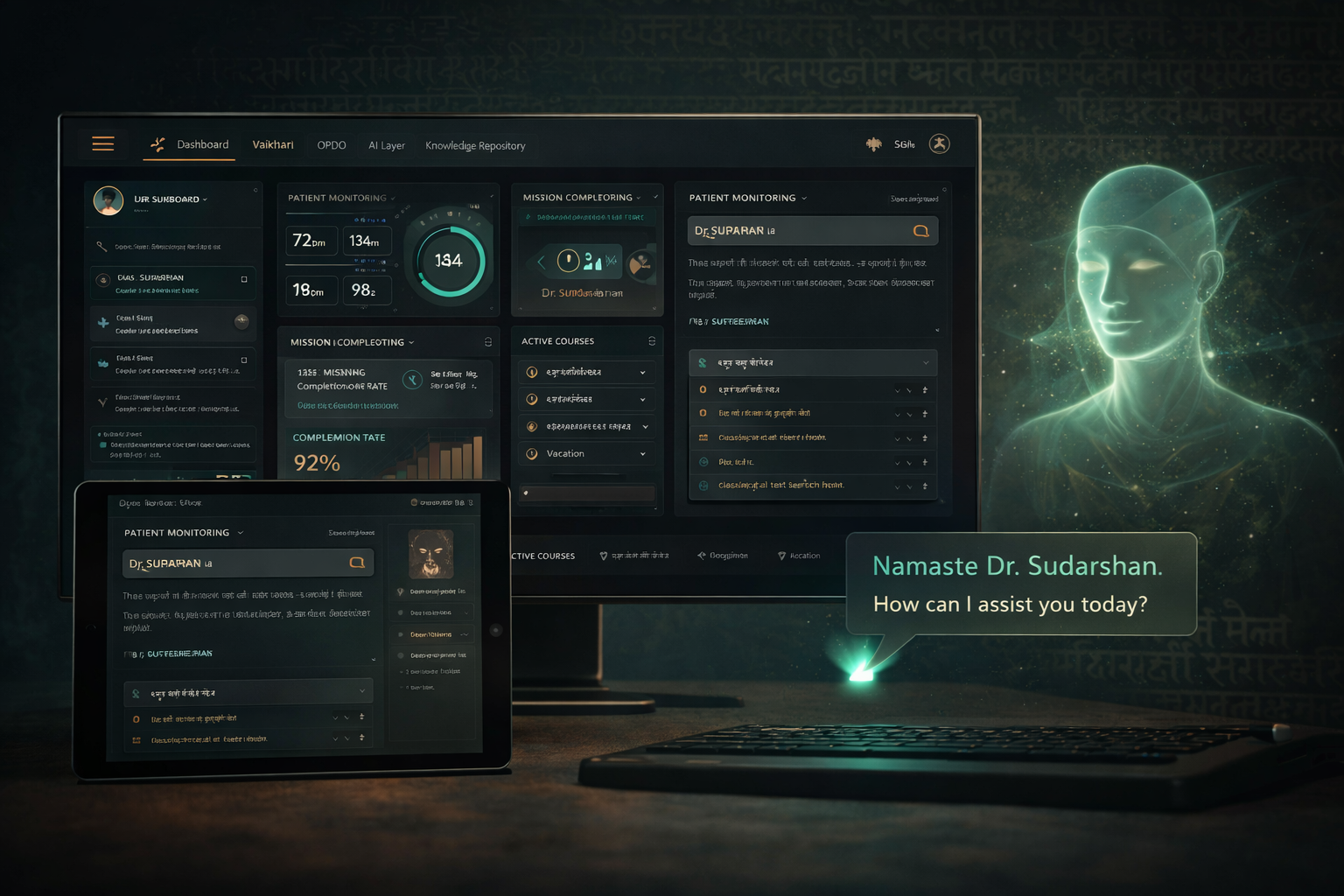
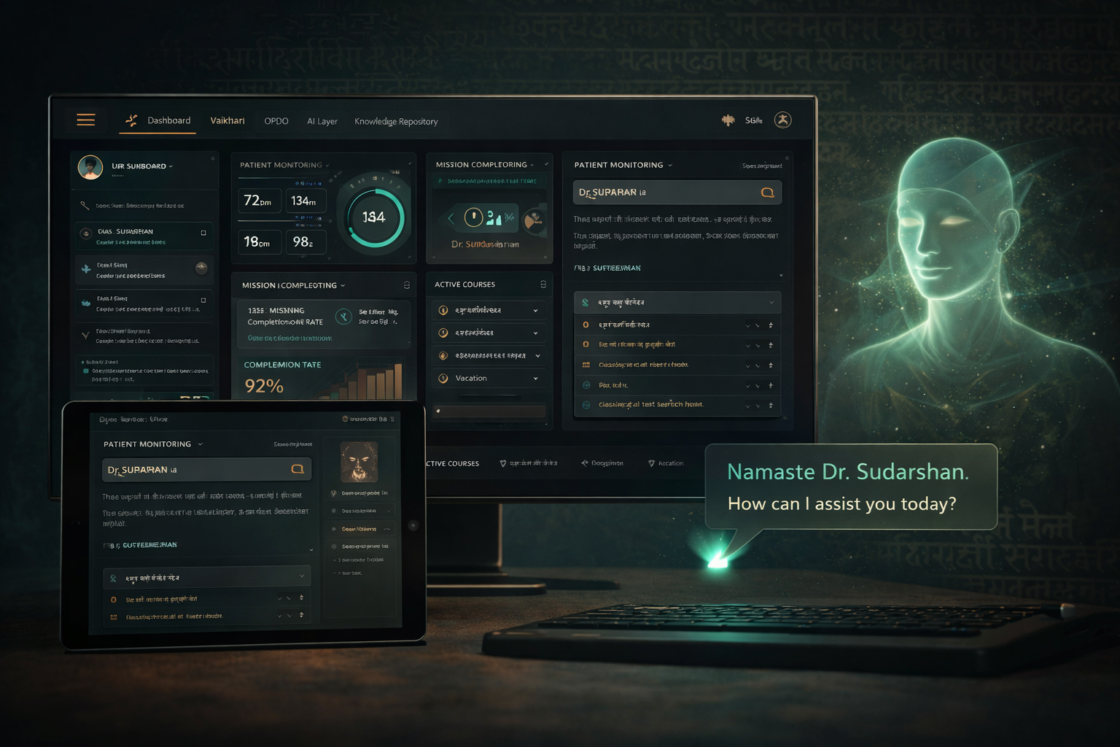
This project was created to address the real operational difficulties faced by doctors, especially in independent clinics, multi-clinic setups, and research-oriented practice environments. It combines OPDO as the clinical backbone, VAIA as the intelligence and automation layer, and Vaikhari as the scholarly and collaborative knowledge layer. The system is designed not merely as software, but as an integrated practice infrastructure that supports care, continuity, analysis, collaboration, and future ecosystem expansion.
/ Challenges
The project had to solve multiple structural challenges at once. Doctors were burdened by fragmented records, repeated documentation, poor continuity across visits, and limited ability to convert practice into structured knowledge. Existing software models were often expensive, rigid, and poorly aligned with real doctor workflows. The challenge was not only technical, but philosophical: to build a system that automates burden without disturbing clinical freedom, supports research without complicating practice, and remains accessible without turning essential infrastructure into a premium barrier.
/ Objectives
The objective of the project was to make clinical work easier, more structured, and more sustainable for doctors. It aimed to reduce dependence on fragmented manual systems, create lifetime patient continuity within the clinic, enable multi-condition tracking, simplify prescription workflows, and convert practice data into meaningful case-study and research-ready structures. Another major objective was to ensure that the core platform remains accessible, while customization and personalization provide scalable commercial value.
/ Final Outcome
Outcome
The project successfully established a unified foundation across OPDO and Vaikhari through single-time onboarding. OPDO was developed as a multi-tenant, multi-clinic, role-based system with completed modules for clinic management, staff management, patient lifetime records per clinic, multi-visit tracking, multi-condition tracking, research forms, prescription generation, collaborative case-study creation, and category-based case-study structuring. VAIA has been infused into the workflow direction for AI-assisted analysis and simplification, while Vaikhari has been positioned as the upcoming scholarly-social layer for collaborative content creation and publication.
Final Result
The result is a substantially built doctor-focused ecosystem that goes beyond conventional clinic software. It has created a strong functional base for accessible clinical infrastructure, case-oriented documentation, collaborative knowledge development, and future automation-led workflow support. Most importantly, it has established a practical model in which essential digital infrastructure is kept open and usable, while personalization, customization, and organizational deployment form the basis of long-term commercial value.