Some systems are built because a market exists. Some are built because a profession is struggling under invisible burdens. OPDO belongs to the second category.
It did not emerge from the desire to merely digitize clinics. It emerged from a much deeper and older observation: Ayurveda doctors were expected to think like physicians, observe like researchers, write like scholars, prescribe like traditional practitioners, communicate like counselors, and manage clinics like administrators—all at once. Their work was not only clinical. It was intellectual, relational, documentary, educational, and operational. Yet the tools available to them reduced their work either to generic software workflows or to fragmented manual systems.
The result was predictable. Clinical brilliance remained trapped inside notebooks, case files, memory, WhatsApp chats, disconnected prescriptions, scattered patient records, and undocumented observations. The physician continued to work, but the system around the physician remained weak.
The seed of solving this problem was visualized by Acharya ji as early as 2011. At that stage, the concern was not just software. The concern was the life of the Ayurveda doctor itself—how much energy was being lost in repetition, documentation burden, follow-up complexity, fragmented patient memory, and inability to transform practice into structured knowledge. That early insight remained alive. Then, during reconstruction in January 2024, the question was taken up again in sharper form: How can the lives of Ayurveda doctors be simplified without disturbing the nature of Ayurveda itself? From that renewed inquiry emerged one of the most refined industry-oriented applications in this space—OPDO, supported by VAIA and connected in logic with Vaikhari.
This case study documents that journey.
The Problem That Was Never Small
The common mistake in healthcare technology is to assume that the problem is paperwork. In reality, the problem is deeper. For Ayurveda doctors, clinical practice sits at the intersection of person, condition, context, formulation, diet, follow-up, interpretation, and longitudinal observation. A patient is not merely a file. A case is not merely a visit. A prescription is not merely a list of medicines. And a clinic is not merely an appointment center.
Yet most available systems treated the entire practice as a simplified administrative process. They helped store data, perhaps generate a bill, perhaps print a prescription, perhaps book a visit. But they did not understand the internal life of Ayurvedic practice. They did not understand that one patient may carry multiple conditions, that the same patient must often be observed across repeated visits, that clinical insight matures through tracked forms, and that case development is not separate from practice but born from it.
This disconnect created several layers of burden.
First, doctors had to repeatedly enter or recollect information that should have evolved naturally across time. Second, case development remained difficult because observation, follow-up, prescription, and interpretation were not structurally connected. Third, research potential was constantly lost because practice data was not shaped in a way that could later become meaningful analysis. Fourth, collaboration between doctors remained weak or informal. Fifth, the physician’s intellectual effort was rarely converted into reusable institutional knowledge.
In short, Ayurveda practice had life, but not enough infrastructure.
The Foundational Insight
The project began with one central understanding: if technology is to serve Ayurveda, it cannot overpower the physician, flatten the case, or turn clinical tradition into checkbox bureaucracy. It must remove friction without removing intelligence. It must automate burden without automating judgment. It must strengthen memory, continuity, and workflow without reducing Ayurveda into generic health-tech language.
From this understanding, OPDO was not designed as a plain clinic management product. It was conceived as a practice infrastructure system for Ayurveda doctors—one that could support clinical care, case continuity, prescriptions, research forms, collaboration, and AI-assisted interpretation under one framework.
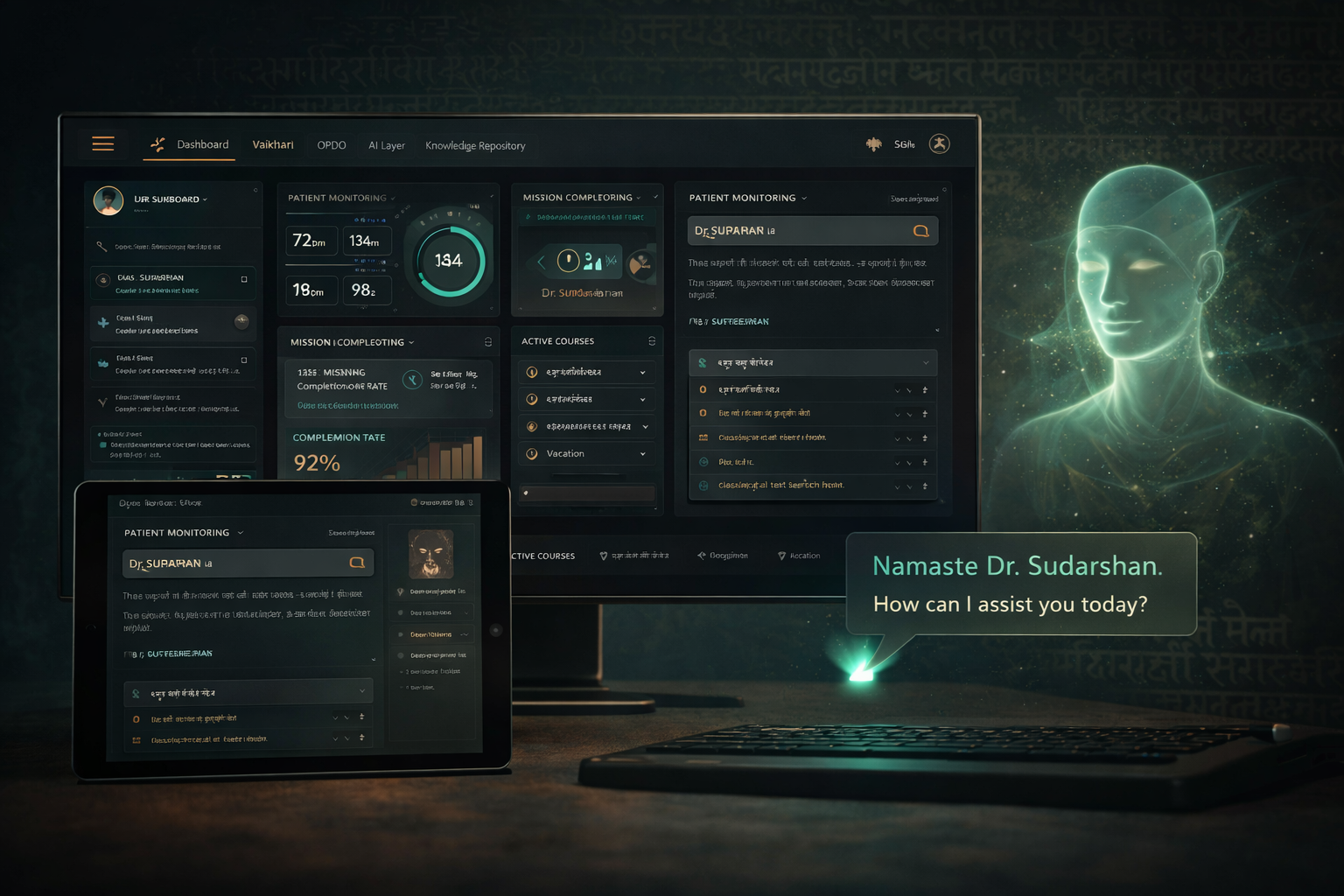
VAIA was then infused into this architecture not as decoration, but as a meaningful intelligence layer. Instead of being a detached chatbot, VAIA was positioned to interact with clinical workflows, automate certain processes, simplify conversations, and ultimately help generate structured case studies from research-form-driven practice. This changed the nature of the platform. OPDO was no longer merely software. It became a conversation-capable, intelligence-assisted, doctor-facing infrastructure.
Alongside this, Vaikhari emerged as the knowledge and scholarly layer—designed not for clinic records alone, but for article creation, collaborative writing, books, content publication, circles, social scholarly interaction, and domain-specific knowledge sharing. Together, these systems formed a larger architecture: clinical work in OPDO, intelligent support through VAIA, and knowledge creation plus publication through Vaikhari.
The Product as It Stands
The current project is not a concept alone. It is substantially built, with real completed layers and a clear philosophy behind them.
At the base is single-time user onboarding across either OPDO or Vaikhari. This is not a trivial convenience feature. It signals architectural unity. The user is not forced into disconnected identities across multiple systems. This reduces friction and prepares the ground for an ecosystem rather than isolated applications.
OPDO itself has been designed as a multi-tenant, multi-clinic platform with role-based access control. This immediately solves a real operational problem: Ayurveda practice is often not limited to a single room, a single location, or a single-person workflow. Clinics need to be created and operated in shared mode. Staff need to be defined and assigned per clinic. Access must be controlled according to role, not improvised informally.
The patient management system is especially important in its logic. One patient record per clinic for a lifetime creates continuity. Multiple visits can be recorded under the same patient. This seems simple on the surface, but it corrects one of the major structural failures of fragmented practice software—the inability to preserve a coherent longitudinal clinical identity.
From there, the system becomes more powerful. The same patient can hold multiple conditions, and those conditions can be tracked through research forms. This is where OPDO separates itself from common clinic software. It does not stop at visit storage. It creates a bridge between practice and analysis. Research forms are not ornamental add-ons; they are the mechanism by which clinical observation can later become structured case material.
The prescription generation layer supports custom pad designs, which respects clinical identity and practice style. The platform does not force the doctor into a generic print culture; it adapts to doctor-specific presentation.
The case study management module takes the next logical step. Doctors can create case studies directly within the platform, and they can do so collaboratively with other doctors. This is crucial. The physician is not merely recording treatment. The physician is building knowledge. Case studies can further be categorized either by context or by patient condition tracked through research forms. This turns case documentation from a loose writing exercise into a structured scholarly workflow.
Several meaningful features are in active progress. A notification system using a WhatsApp BYOK model is underway, allowing communication without forcing a single rigid messaging dependency. VAIA-based AI analysis is being developed to interpret research form data and assist in generating case studies. Beyond that, an AI-assisted workflow layer is being used to simplify and automate several tasks. This indicates that intelligence is being integrated where it reduces burden and improves usable output, not merely where it appears fashionable.
Some features remain pending in Phase 1, but their place in the architecture is clear. Inventory management and billing are natural extensions of the clinic infrastructure and will strengthen operational completeness.
On the Vaikhari side, the work is equally strategic. Vaikhari is being shaped as a scholarly-social platform where users can create articles and books individually or collaboratively, publish to private or public circles, share daily posts, comment, connect, and use story-based interaction. Organization-level customization is planned, along with single-page application deployment for institutions. This means the platform is capable of serving both individuals and structured organizations.
The patient portal, once completed, will allow patients to view appointments, book appointments, access prescriptions, see diet plans, and manage records. This is not just a convenience layer. It is a continuity layer for care.
The vendor pipeline and ERP integration represent another important future direction. Vendors will be onboarded, allowed to list products, manage inventory, and sell directly to clinics, while clinics can procure directly from the vendor platform. This creates a supply-side dimension that can eventually turn the platform into a more complete professional ecosystem.
What Makes the Model Different
Perhaps the most powerful strategic choice in this project is the business model.
The platform itself is being kept without fees, while charges are applied only for personalization. This is not merely a pricing decision. It is a philosophical decision. It lowers adoption resistance for doctors, encourages ecosystem participation, and aligns the platform with service rather than gatekeeping. At the same time, personalization remains a legitimate commercial layer because each doctor, clinic, institution, or organization may require customized pad designs, custom flows, theme configurations, organization-level deployments, workflow tuning, or brand-linked structuring.
In effect, the core infrastructure remains accessible, while revenue is generated from tailored value. This model is especially suited to trust-building domains like Ayurveda, where forcing subscription barriers too early can slow adoption and fragment community formation.
Why This Matters for Ayurveda Doctors
The real value of OPDO is not that it digitizes a clinic. Its value is that it returns cognitive and operational space back to the doctor.
A doctor who does not have to reconstruct a patient’s history from memory gains clarity. A doctor who can track multiple conditions across multiple visits gains continuity. A doctor who can connect research forms to case study generation gains scholarly productivity. A doctor who can collaborate with another doctor on case material gains a higher level of intellectual practice. A doctor who can use AI assistance to reduce repetitive burden gains time for observation and judgment rather than data-entry fatigue.
This is where simplification becomes meaningful. Simplification does not mean making the work shallow. It means removing the unnecessary weight that prevents the physician from working at full depth.
The Role of VAIA
VAIA’s importance within this system deserves separate attention. Too many digital products attach AI after the product is built and then search for uses. Here, VAIA has been fused into the workflow with clear intent.
It is being used to analyze research-form data, assist in case study generation, and simplify task execution. More importantly, the project vision suggests a broader interaction model where clinic workflow itself becomes more conversation-based. This is a significant step. It points toward a future in which the physician may not always have to navigate software mechanically. Instead, the system can respond, assist, and structure work through intelligent interaction.
For Ayurveda, this is particularly meaningful because the tradition itself is rich in layered observation, contextual conversation, and interpretive flow. A conversation-capable infrastructure is therefore far more aligned with actual doctor behavior than a rigidly form-driven system alone.
The Role of Vaikhari
If OPDO is the practice backbone and VAIA is the intelligence layer, then Vaikhari is the knowledge civilization layer.
Clinical systems alone are insufficient if they do not eventually produce scholarship, publication, discussion, and preserved learning. Vaikhari addresses that need. It allows content creation individually or collaboratively. It supports books and articles. It enables publication to private, selected, or public audiences. It includes social interaction—posts, comments, connections, stories—but within a scholarly environment rather than empty engagement mechanics.
This means knowledge can move from private insight to structured publication without leaving the broader ecosystem. A clinic-generated case may one day become a case study. A case study may become an article. An article may contribute to broader community knowledge. That movement is what turns software into infrastructure.
Strategic Significance
Taken together, OPDO, VAIA, and Vaikhari represent a shift from isolated digital tools toward an integrated Ayurveda operating environment.
This environment serves practice, knowledge, collaboration, continuity, and publication together. It acknowledges that a physician is not just a service provider. A physician is also an observer, thinker, documenter, and contributor to collective knowledge. By respecting this fuller identity, the project rises beyond simple clinic software.
Its significance is also strategic from an industry perspective. Most medical software systems are built from generalized assumptions and later adapted to specialities. This project moves in the opposite direction. It is built from the internal logic of the domain. That is why it has the potential to become one of the best industry applications in its category—not because it copies standard health-tech models better, but because it understands the profession more honestly.
Final Outcome
This project began as a long-held vision in 2011. It was reconsidered with sharper urgency in January 2024 through the lens of simplifying the lives of Ayurveda doctors. It has since matured into a substantially built, functionally rich, intelligence-assisted infrastructure.
Its completed foundations already demonstrate the seriousness of the effort: unified onboarding, multi-clinic architecture, role-based operations, patient continuity, condition tracking, research forms, custom prescriptions, case study management, doctor collaboration, and a developing AI-assisted workflow. Its larger ecosystem vision further strengthens it: scholarly publication, collaborative authorship, patient access, organization customization, and future vendor-network integration.
The result is not merely software. It is an attempt to restore proportion between the depth of Ayurveda practice and the quality of the systems that support it.
That is why this case study matters.
Because the true achievement here is not that a digital platform was built. The true achievement is that the life of the Ayurveda doctor was finally taken seriously enough to deserve one.