
A Comprehensive Case Study on Bridging Traditional Knowledge Systems, Collaborative Scholarly Authoring, and Modern Publication Networks in the Digital Era
Introduction
As the global academic, scientific, and educational paradigms undergo an unprecedented and accelerated digital migration driven by the systemic disruptions of the current global pandemic, the foundational infrastructures supporting human knowledge are being rigorously stress-tested. In this climate of rapid technological adaptation, the Indian educational and healthcare policy landscape has experienced a monumental paradigm shift. The passage of the National Education Policy (NEP) in July 2020 established a definitive mandate to reintegrate Indian Knowledge Systems (IKS), multilingual education, and traditional philosophical sciences into the mainstream higher education curriculum. In immediate succession, the enactment of the National Commission for Indian System of Medicine (NCISM) Act in September 2020 signals a comprehensive regulatory overhaul aimed at standardizing and elevating the medical education of Ayurveda, Unani, Siddha, and Sowa-Rigpa to globally recognized paradigms of excellence.
These legislative and policy frameworks articulate an ambitious vision: the elevation of traditional Indic scholarship and Ayurvedic clinical practice to a standard of global competitiveness and scientific validation. However, this strategic intent immediately collides with a severe, structural infrastructural void. While the policy mandates are unequivocally clear, the digital tools required to facilitate this transition are fundamentally lacking across the ecosystem. The existing digital architecture for academic collaboration, primary text preservation, and scholarly publishing has been designed, iteratively refined, and optimized almost exclusively for Western, English-centric, and STEM-oriented epistemologies. These legacy platforms systematically fail to accommodate the unique linguistic rendering, ontological structures, and collaborative methodological demands inherent to Indic knowledge systems.
The current paradigm is characterized by a paradox of immense intellectual wealth severely constrained by digital poverty. India possesses over 755,000 registered Ayush practitioners, supported by a vast network of 886 undergraduate and 251 postgraduate colleges. Yet, the volume of high-quality, peer-reviewed clinical case studies and research publications generated by this massive demographic remains disproportionately low when measured against global biomedical output. Similarly, the rich traditions of Sanskrit literary and philosophical commentary are trapped in static, unsearchable digital image repositories that inhibit dynamic scholarly engagement.
This case study reconstructs the strategic, functional, and commercial necessity of conceptualizing and deploying “Vaiklhari”—a comprehensive, unified digital knowledge infrastructure platform. Vaiklhari is not conceived merely as a discrete software application, a generic social network, or a static institutional repository. It is architected as a foundational digital ecosystem specifically designed to seamlessly integrate primary knowledge creation, advanced archival functions, collaborative scholarly writing, structured clinical case reporting, domain-specific publication workflows, and authenticated social knowledge exchange. By dissecting the structural bottlenecks inherent in the current academic publishing and repository ecosystems, this report articulates why the creation of Vaiklhari is an inevitable, strategic, and essential evolution required for the survival, global proliferation, and empirical validation of Ayurveda and Indic scholarship in the twenty-first century.
The Structural Problem
The contemporary landscape of digital scholarship is afflicted by severe systemic fragmentation, which creates immense epistemological friction for scholars operating outside the dominant Western paradigms. The lifecycle of academic knowledge—which ideally spans the discovery of primary texts, collaborative research and drafting, peer review, publication, and subsequent scholarly discourse—is currently scattered across disparate, non-integrated, and often incompatible technological platforms. This fragmentation poses distinct, insurmountable challenges for Indic scholarship and traditional medicine.
The first major structural failure lies in the architecture of current digital libraries and institutional repositories. Initiatives such as the Digital Library of India (DLI), the Internet Archive, and various university-led Sanskrit digital libraries have performed the vital task of preventing the physical decay of ancient manuscripts by digitizing them. However, these repositories function primarily as static storage silos. Users are frequently forced to download texts as isolated, unsearchable TIFF images or flat PDF files, which are entirely divorced from any active workspace. The archive is isolated from the authoring desk. A scholar cannot dynamically query these texts, extract semantic data, or seamlessly link a specific ancient verse to a modern collaborative document. The archival philosophy remains rooted in preservation rather than active, dynamic utilization, rendering the knowledge inaccessible for modern computational analysis or rapid collaborative translation.
The second structural failure is the inadequacy of general-purpose scholarly collaboration networks. Platforms such as ResearchGate and Academia.edu operate predominantly as post-publication aggregators and metric-tracking dashboards rather than genuine environments for knowledge creation. They are optimized for the dissemination of completed, peer-reviewed PDFs and the gamification of bibliometric indices, such as citation counts and impact factors. They do not offer synchronous, native authoring tools designed for the unique requirements of traditional scholars. Furthermore, the underlying socio-technical architecture of these platforms privileges modern scientific methodologies and English-language publications, creating subtle but pervasive barriers for researchers operating within traditional knowledge paradigms where community consensus and classical textual alignment carry different epistemic weight.
The third, and perhaps most debilitating, structural failure occurs at the level of word processing and document typesetting. The tools utilized for the actual creation of scholarly documents—such as Microsoft Word or the complex typesetting system LaTeX—present severe friction when applied to Indic languages and traditional textual structures. Traditional Indic scholarship is fundamentally non-linear, intertextual, and highly interconnected. A foundational text, known as the Mula Sutra or Shloka, is rarely studied in isolation; it is historically expanded upon through concentric, nested layers of commentary over centuries. This includes the Bhashya (the primary, detailed commentary), the Vartika (a critical gloss that analyzes what is said, unsaid, or poorly said in the original), the Vivaraṇa (a deeply analytical expansion), and the Dipika or Tika (illuminating sub-commentaries). Attempting to map this multi-layered, concurrent, and highly interdependent commentary tradition onto the linear, chronologically paginated format of standard word processors results in immediate formatting collapses, semantic loss, and an inability to trace intellectual lineages. Scholars are forced to use cumbersome footnotes that divorce the commentary from the root text, destroying the pedagogical intent of the original authors.
In the specific domain of Ayurveda, this infrastructural deficit manifests as a critical gap in clinical evidence generation. The Indian Ayurvedic ecosystem is massive, but its integration into evidence-based global healthcare is hindered by documentation failures. While Ayurveda practitioners successfully treat millions of patients, including complex chronic conditions and emerging threats such as the novel coronavirus , the volume of this clinical success translated into high-quality, peer-reviewed clinical case studies is minimal. This is not due to a lack of clinical efficacy, but rather the total absence of accessible, standardized digital workflows. Global medical reporting relies on stringent frameworks like the CARE (CAse REport) guidelines to ensure transparency and accuracy. However, these generic guidelines must be uniquely adapted to Ayurvedic parameters (AYUR-CASE) to accurately capture foundational Ayurvedic concepts such as Prakriti (individual constitution), Dosha imbalances, and Samprapti (pathogenesis). Currently, practitioners lack a dedicated, intelligent platform that guides them through these rigorous reporting standards seamlessly during their clinical practice, thereby stalling the critical transition of Ayurveda from “practice-based evidence” to globally validated “evidence-based practice”.
Why Vaiklhari Had to Be Created
Given the compounding structural bottlenecks outlined above, the conceptualization and creation of Vaiklhari emerges not as an opportunistic commercial venture, but as a critical, unavoidable infrastructural necessity. To successfully elevate Indic knowledge systems to a globally competitive standard, as mandated by the sweeping educational reforms of 2020, the academic and medical ecosystem requires an integrated pipeline that completely eliminates the friction between reading an ancient text, debating its meaning, applying it in a clinical setting, and publishing a modern scientific paper validating its efficacy.
Vaiklhari had to be created because generic software simply cannot solve domain-specific epistemological and ontological challenges. Software is not neutral; its architecture dictates the boundaries of what can be thought, written, and shared. When an Ayurvedic scholar wishes to publish an intricate clinical case study detailing the holistic management of Pandu Roga (anemia) through customized shodhana (purification) and shamana (pacification) therapies , they require a digital environment that intrinsically understands Ayurvedic terminology. They need a system that standardizes the reporting parameters automatically, and directly links the observed clinical outcomes to classical canonical texts like the Charaka Samhita without requiring manual, error-prone formatting.
Furthermore, Vaiklhari is an absolute necessity to democratize scholarly production and alleviate the immense cognitive load placed on researchers. The current technical barriers—struggling with inaccurate Sanskrit Optical Character Recognition (OCR), navigating highly complex LaTeX transliteration packages (such as tipa and fontspec) just to properly stack diacritics, and managing fragmented peer-review communication over email—exhaust the intellectual bandwidth of traditional scholars. By providing a unified, cohesive platform where the digital library, the collaborative writing desk, the clinical reporting template, the double-blind peer-review panel, and the final publisher are integrated under one digital roof, Vaiklhari allows scholars to focus entirely on intellectual knowledge creation rather than software management. It effectively serves as a digital Gurukula—a collaborative, continuous, authenticated, and self-sustaining ecosystem for knowledge generation and preservation. It bridges the chasm between the ancient oral and manuscript traditions and the modern imperative for structured, verifiable, and globally discoverable digital data.
Platform Vision and Functional Scope
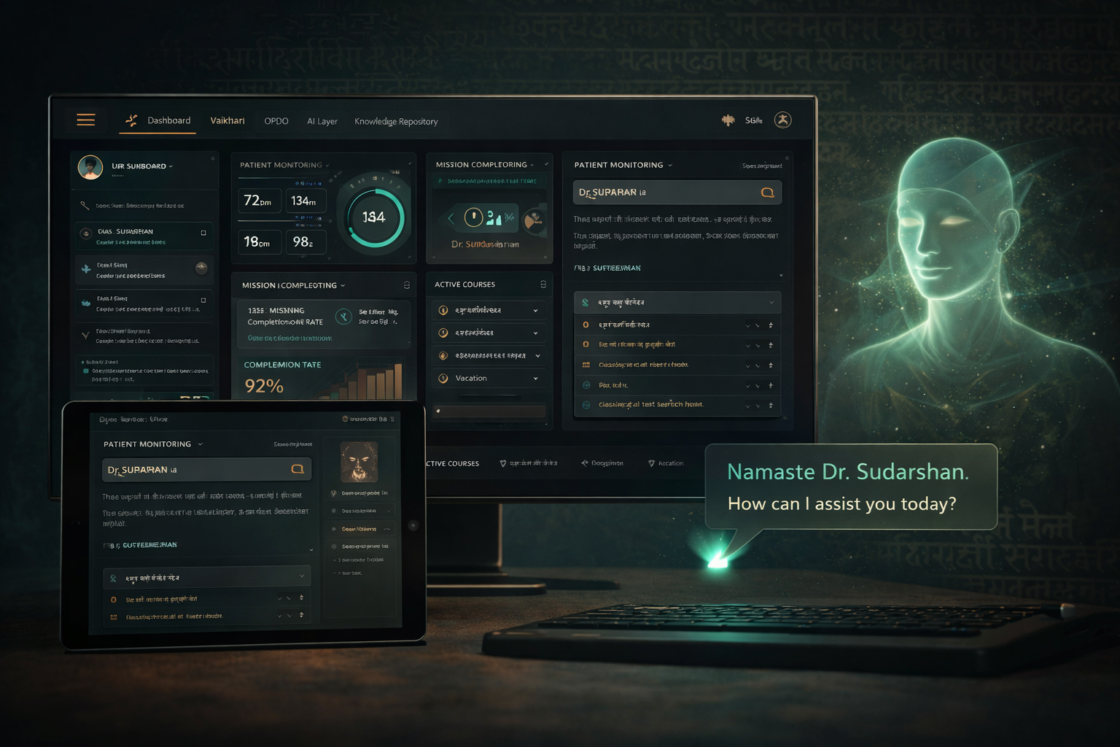
Vaiklhari is architected as a comprehensive Knowledge Infrastructure Platform (KIP), representing a paradigm shift in how specialized academic ecosystems operate. Its functional scope actively transcends the traditional, isolated boundaries of a Content Management System (CMS), an Institutional Repository (IR), or a Learning Management System (LMS). Instead, it harmonizes these distinct functionalities into a cohesive, uninterrupted scholarly workflow. The platform’s vision is realized through several sophisticated, interconnected core modules.
The foundation of the platform is a deeply Searchable Digital Knowledge Base and Archive. Vaiklhari operates as a dynamic, living library rather than a digital graveyard of scanned images. Utilizing advanced, domain-specific Indic Optical Character Recognition (OCR) and Natural Language Processing (NLP) models trained specifically on the morphological complexities of Sanskrit and traditional texts, the platform ingests ancient manuscripts and renders them machine-readable. This repository supports deep semantic search capabilities, allowing users to query texts effortlessly across different Indic scripts and global transliteration standards. Crucially, the architectural design of this archive preserves the relational integrity of the texts, maintaining the historical, hyperlinked connections between a root Sutra and its centuries of subsequent Bhashya and Vartika commentaries, allowing users to navigate the epistemology exactly as traditional scholars intended.
Integrated directly above this archival layer is the Collaborative Authoring Workspace. This environment is specifically engineered for academic, multilingual, and traditional knowledge creation, functioning as a domain-specific word processor. It supports synchronous, multi-author collaboration in real-time, eliminating version control nightmares. The workspace natively handles the complex rendering of Sanskrit, precise diacritic stacking, and seamless multilingual input, completely removing the need for users to learn complex typesetting codes. This module facilitates the drafting of everything from short articles to extensive white papers and full-length academic books, providing integrated citation management that pulls directly and contextually from the platform’s underlying digital library.
For the Ayurveda and AYUSH sectors, Vaiklhari introduces highly Structured Case-Study and Clinical Reporting Pipelines. Recognizing the critical need to build evidence-based literature, the platform incorporates algorithmic templates based strictly on the CARE guidelines and their specific AYUR-CASE extensions. These intuitive templates guide physicians step-by-step in documenting patient demographics, clinical findings, Ayurvedic diagnostic assessments (such as Nadi Pariksha or pulse diagnosis), therapeutic interventions, and longitudinal outcomes. This rigorous architectural enforcement ensures that every clinical case study generated on the platform is inherently standardized, properly formatted for peer review, and capable of withstanding rigorous global scientific scrutiny.
To complete the scholarly lifecycle, Vaiklhari incorporates an End-to-End Publication and Dissemination Engine. This module bridges the historically fragmented gap between manuscript submission, review, and final dissemination. It provides comprehensive tools for editorial board management, the facilitation of double-blind peer reviews, and automated digital typesetting into standardized academic formats (PDF, XML, HTML). This infrastructure empowers academic institutions, Ayurvedic colleges, and independent traditional knowledge societies to operate their own publishing pipelines efficiently and professionally, drastically reducing their reliance on expensive, generic third-party publishing conglomerates while ensuring their research reaches a global audience.
Wrapping these functional tools is an Authenticated Scholarly Social Network layer. Unlike the noisy, algorithmically driven environments of generic consumer social media, or the rigidly metric-driven interfaces of existing academic networks, Vaiklhari fosters a community-driven, domain-specific scholarly interaction layer. It enables knowledge sharing, post-publication review, and rigorous academic discourse among verified scholars, researchers, and licensed physicians. This social layer is deeply and contextually integrated with the content; users do not just share links, they can debate a specific interpretation of a shloka or the efficacy of an herbal compound directly in the interactive margins of a shared digital text or published case study, ensuring that peer review becomes a continuous, living process.
Benefits and Strategic Relevance
The deployment of Vaiklhari generates compounding, long-term strategic value across multiple distinct stakeholder segments within the Indian and global academic and healthcare ecosystems.
For traditional scholars, linguists, and researchers, Vaiklhari entirely removes the deep technical friction associated with multilingual, script-heavy academic writing. Scholars are no longer burdened with formatting battles; they benefit from an intuitive, highly responsive interface that inherently respects the orthography and structure of Indic languages. The platform provides them with enhanced global visibility, rigorous peer-collaboration tools, and a secure, cloud-based environment to develop complex treatises, interdisciplinary white papers, and translations without the pervasive fear of formatting corruption or data loss that plagues generic software.
For Ayurveda physicians, clinicians, and medical practitioners, the platform offers a streamlined, scientifically rigorous mechanism to convert their daily, localized clinical successes into published, globally accessible empirical evidence. By radically lowering the barrier to writing structured, guideline-compliant case studies, Vaiklhari empowers individual practitioners to actively participate in the creation of a massive, searchable clinical database. This not only elevates the individual physician’s professional standing and career trajectory but, more importantly, collectively builds the robust empirical foundation required to validate Ayurvedic protocols on the global biomedical stage, fulfilling a critical public health mandate.
For students and higher educational institutions, Vaiklhari aligns perfectly with the statutory mandates of the NEP 2020 and the NCISM Act. It provides universities and colleges with a ready-made, state-of-the-art digital infrastructure to promote Indian Knowledge Systems and modernize medical education. Students gain access to a modernized, highly interactive pedagogy where they can engage directly with primary texts, collaborate on complex assignments, and learn the rigorous standards of academic publishing early in their academic careers. For the institutions themselves, Vaiklhari serves as a robust internal knowledge repository and a turnkey institutional press, significantly enhancing their accreditation metrics, publication output, and institutional rankings (such as NAAC and NIRF) by streamlining faculty research pipelines.
For academic publishers, editorial boards, and traditional knowledge communities, Vaiklhari offers a highly cost-effective, deeply specialized alternative to legacy publishing software systems. By streamlining the editorial and typesetting workflows specifically tailored for Indic and Ayurvedic content, the platform drastically reduces the time-to-publication and significantly lowers administrative overhead costs. For traditional knowledge communities, it ensures that their civilizational heritage is not merely archived as a decaying relic, but remains a vibrant, actively debated, and continuously expanding body of living knowledge, seamlessly integrated into modern educational frameworks.
Indic Language and Traditional Knowledge Requirements
To fully comprehend the necessity of Vaiklhari, one must deeply examine the technical and linguistic inadequacies of current software paradigms. The digital representation of Sanskrit and other Indic languages is not a superficial matter of cosmetic localization—it is not merely about changing the interface language from English to Hindi. Rather, it is a profound, foundational system design issue that dictates the architecture of the underlying database, the text rendering engine, and the search algorithms.
The primary challenge lies in the complex morphology and script architecture of Indic languages. Sanskrit orthography is highly intricate, characterized by the extensive use of consonant conjuncts (ligatures) and arbitrarily long, heavily compounded words formed through rigorous Sandhi (euphonic combination) rules. Standard optical character recognition (OCR) systems, which have been trained and optimized to parse the distinct, linearly spaced lettering of Latin scripts, fail dramatically when applied to Classical Indic documents, resulting in high character error rates and unusable digital text. Vaiklhari’s architecture must inherently support and integrate specialized, attention-based computational linguistics models and morphological parsers specifically trained on Indic syntax to ensure accurate digitization and searchability.
Furthermore, a robust platform must ensure absolute semantic interoperability through dynamic transliteration and searchability. A scholar located in Kerala must be able to input text using the Malayalam script, while a researcher in Germany must be able to seamlessly search for, and view, that exact same text rendered in the International Alphabet of Sanskrit Transliteration (IAST) or standard Devanagari. This level of interoperability requires an underlying data structure where the text is stored in a highly standardized, script-agnostic encoding (such as Unicode or SLP1) and is rendered dynamically at the user interface level based on user preference. Generic document collaboration tools and word processors do not support this level of dynamic, cross-script phonetic transliteration natively, severely limiting cross-regional and international scholarly collaboration.
Equally critical is the digital preservation of the ontology of the commentary tradition. As previously established, the Indian Shastra (scientific and philosophical) tradition relies heavily on the nested Bhashya and Vartika structures. A single root verse may possess multiple, intersecting commentaries authored by different scholars over several centuries. Modern word processors, built entirely on the paradigm of a physical, linear piece of paper, attempt to handle this complexity through cumbersome footnotes or endnotes. In a complex traditional text, this approach quickly becomes visually unreadable and pedagogically useless. Vaiklhari addresses this foundational requirement by treating text not as a flat document, but as a relational database. A user reading a root text on the platform can dynamically toggle various historical commentaries on or off, viewing them contextually and parallel to the original verse. This semantic linking and hierarchical structuring is a foundational requirement for genuine Indic scholarship, transforming Vaiklhari from a mere writing tool into a sophisticated epistemological engine capable of representing the true depth of traditional knowledge.
Market Opportunity and Market Size
Assessing the strategic market opportunity for Vaiklhari in September 2020 requires analyzing the convergence of several rapidly expanding sectors: the Indian Higher Education ecosystem, the exploding EdTech market, the institutional AYUSH healthcare sector, and the global scholarly collaboration software industry.
The Total Addressable Market (TAM) for Vaiklhari encompasses the global markets for educational technology, academic publishing infrastructure, and enterprise collaboration software. The global EdTech and smart classrooms market is on a rapid growth trajectory, projected to reach over USD 350 billion within the decade. Concurrently, the global collaboration software market, driven by the shift to remote work and digital operations, is valued at approximately USD 18.2 billion. Furthermore, the global academic publishing and associated workflow tools market generates tens of billions of dollars annually. Consequently, the theoretical TAM for a comprehensive, globally scalable digital knowledge and collaboration infrastructure exceeds USD 15 Billion (approx. INR 1,10,000 Crores).
However, a more realistic Serviceable Addressable Market (SAM) is identified by narrowing the focus specifically to the Indian domestic context, focusing on higher education digitization, institutional repositories, and specialized academic publishing tools. The Indian higher education sector is vast, encompassing over 31 million students. Driven by the pandemic and the mandates of the NEP 2020, the Indian EdTech market is experiencing explosive growth, projected to rise from USD 700-800 million in 2021 to an estimated USD 30 billion by 2031. Within this massive expansion, the specific market for localized higher-education digital infrastructure, academic publishing services, and specialized laboratory/research information systems (LIMS) in India forms the SAM. Valuing the specialized academic software, LIMS, and digital library infrastructure segments in India yields a highly lucrative SAM of approximately USD 1.5 to 2 Billion (approx. INR 11,000 to 15,000 Crores).
The immediate, highly targeted Serviceable Obtainable Market (SOM) for Vaiklhari consists of the AYUSH educational and professional ecosystem, alongside institutions focused on Indic Knowledge Systems, Sanskrit, and traditional arts.
| Market Segment | Target Population / Institutions | Estimated Penetration (Early Adoption) | Projected Direct Reach |
| Institutional Tier (B2B) | ~700 AYUSH Medical Colleges + Sanskrit Universities | 20% | ~150 Institutions |
| Professional Tier (B2B2C) | 755,780 Registered AYUSH Practitioners | 5% | ~37,789 Professionals |
Assuming a conservative commercial model where Vaiklhari captures 20% of the institutional market (150 institutions paying an average enterprise SaaS licensing fee of USD 10,000/year for bespoke institutional deployment) and 5% of the practitioner market (37,789 professionals paying a premium subscription of USD 100/year for advanced clinical tools), the initial SOM equates to roughly USD 5.27 Million (approx. INR 39 Crores) in direct, recurring annual software revenue. This figure represents only the baseline SaaS revenue and is entirely exclusive of massive upside potential from ancillary publishing fees, digital archival services, and API licensing to larger government frameworks.
Commercialization Pathways
To ensure long-term sustainability, continuous technological advancement, and the maintenance of secure cloud infrastructure, Vaiklhari must be aggressively yet ethically commercialized. Crucially, commercialization does not weaken the platform’s scholarly mission; rather, it provides the robust financial foundation necessary to maintain high-quality data security, provide continuous server uptime, and fund ongoing, expensive research into AI and Indic NLP. The platform can deploy a highly diversified, multi-tiered monetization strategy tailored to different user segments:
The primary revenue engine involves Institutional Enterprise Licensing (B2B SaaS). Vaiklhari can license its comprehensive platform directly to Ayurveda colleges, Sanskrit universities, research institutes, and government bodies (such as the CCRAS or AIIA). A comprehensive institutional license provides the university with a branded, private deployment of the platform. This enterprise tier includes advanced administrative controls, student assignment management modules, collaborative thesis authoring environments for postgraduates, secure institutional repository hosting, and an integrated faculty publication pipeline.
Complementing institutional sales are Premium Professional Subscriptions (B2C/B2B2C). To stimulate rapid user acquisition and network effects, core viewing, basic text searching, and standard social networking features should remain free. However, highly specialized, productivity-enhancing tools will be gated behind a premium subscription for individual independent researchers, private Ayurvedic physicians, and specialized scholars. Premium features would include access to advanced clinical case templates (strict AYUR-CASE compliance), unlimited access to proprietary, deep-indexed archival databases, complex cross-script phonetic translation tools, and advanced citation management and export functionalities.
Furthermore, Vaiklhari can monetize through Publication Workflow and Editorial Services. The platform can charge a comprehensive platform-as-a-service fee for independent academic journals, societies, or university presses that wish to utilize the system to manage their entire peer-review and publishing workflows. Additionally, Vaiklhari can offer value-added “assisted publishing services,” including automated digital typesetting, DOI assignment, plagiarism checking, and metadata generation, charging a transparent per-article processing charge (APC) or flat service fee.
Finally, the platform can generate significant revenue through its API and Infrastructure Layer. As Vaiklhari develops highly sophisticated, proprietary Indic NLP, OCR, and transliteration algorithms, these computational engines can be monetized via API access. Other educational technology companies, governmental digital health records systems, or large-scale digital libraries could pay licensing fees to integrate Vaiklhari’s superior language processing capabilities into their own disparate systems, establishing Vaiklhari as the foundational infrastructural layer for all Indic digital text processing.
Potential Use Cases
The architectural flexibility and depth of Vaiklhari allow it to seamlessly serve a wide array of highly specific, high-value scenarios within the Indic knowledge ecosystem, replacing fragmented workflows with unified efficiency:
Use Case 1: The Ayurveda Postgraduate Clinical Thesis Workflow A third-year MS (Ayurveda) postgraduate student at the National Institute of Ayurveda is required to submit a comprehensive clinical thesis evaluating a specific therapeutic protocol. Using Vaiklhari, the student utilizes the structured clinical reporting module to input detailed patient data daily. The platform’s algorithm automatically formats the incoming data to align strictly with standard CARE and AYUR-CASE reporting guidelines, ensuring no vital diagnostic parameters are omitted. Simultaneously, the student’s thesis guide logs into the platform, reviews the ongoing clinical data synchronously, and leaves contextual, actionable comments directly on the patient reports. Once the thesis is finalized and defended, the institution seamlessly pushes the approved document into its Vaiklhari-hosted digital repository, making it immediately searchable and accessible for future researchers, thus closing the loop from clinical practice to published evidence.
Use Case 2: Collaborative Manuscript Translation and Critical Commentary A multidisciplinary team of three Indologists—located in Pune, Oxford, and Tokyo—are collaborating on the first critical edition and English translation of a newly discovered, highly complex 12th-century Sanskrit manuscript on statecraft. They utilize Vaiklhari’s collaborative authoring workspace. The platform allows them to view the high-resolution scanned image of the original palm leaf, the OCR-generated Devanagari text, and their working English translation side-by-side in a synchronized interface. They utilize the platform’s hierarchical linking capabilities to attach extensive Tika (notes) to specific ambiguous words, debating the precise etymology and historical context in the integrated, text-anchored discussion thread. The platform effortlessly handles the diacritic stacking required for the English transliteration, eliminating the need for complex LaTeX coding.
Use Case 3: Rapid Institutional White Paper Generation on Public Health Interventions During a fast-moving public health crisis, such as the initial waves of the COVID-19 pandemic, the All India Institute of Ayurveda (AIIA) coordinates a massive observational study across multiple state hospitals to evaluate the efficacy of specific Ayurvedic prophylactic formulations. Hundreds of field practitioners input their daily clinical observations directly into Vaiklhari’s structured, cloud-based data capture forms. The central research team uses Vaiklhari’s real-time data aggregation and analysis tools to synthesize this massive influx of clinical input into a comprehensive, standardized white paper. The platform allows them to seamlessly format, peer-review, and publish the findings within weeks rather than months, drastically accelerating the time from raw clinical observation to published, actionable public health evidence.
SWOT Analysis
To objectively evaluate the strategic viability and market positioning of Vaiklhari as of September 2020, a rigorous, domain-specific SWOT analysis is necessary:
| Category | Strategic Factors and Analysis |
| Strengths | Deep Domain Specificity: By engineering the platform specifically for the morphological complexities of Indic scripts and the non-linear ontological structures of traditional knowledge (e.g., the Bhashya tradition), Vaiklhari establishes a massive, defensible competitive moat. Generic platforms cannot easily replicate this without fundamentally rebuilding their core database architecture. First-Mover Advantage in Clinical Ayurveda: There is currently no unified, widely adopted digital platform exclusively dedicated to standardizing Ayurvedic clinical case reporting and publishing using AYUR-CASE parameters. End-to-End Integration: The seamless combination of library, authoring tool, and publication engine significantly reduces user friction compared to patching together multiple software solutions. |
| Weaknesses | High Initial R&D Overhead: Developing highly accurate OCR for degraded ancient Sanskrit manuscripts and training bespoke, robust NLP models for complex Indic languages is computationally demanding and financially expensive. Behavioral Inertia: The target demographic, particularly older traditional scholars, senior academicians, and highly experienced practicing Ayurveda physicians, may exhibit high initial resistance to adopting entirely new digital workflows, regardless of the platform’s demonstrated efficiency. |
| Opportunities | Policy Tailwinds: The recent, forceful implementation of the NEP 2020 explicitly mandates the integration of IKS and multilingual education across the country. Vaiklhari is perfectly positioned to serve as the preferred technological enabler for these government directives, opening lucrative avenues for massive state-sponsored institutional deployments. Global Interest in Alternative Medicine: The pandemic has triggered an unprecedented global surge in interest regarding holistic immunity and traditional medicine. A platform that provides rigorous, peer-reviewed Ayurvedic evidence stands to capture a massive, engaged global academic and consumer audience. |
| Threats | Big Tech Encroachment: Major global technology conglomerates (such as Microsoft or Google) are continually expanding their localized language support and could potentially release lightweight, integrated academic tools that, while lacking deep epistemological depth, might capture market share through sheer distribution power and existing enterprise bundling. Prolonged Open Access Funding Debates: As the global academic publishing model shifts disruptively towards Open Access, defining who ultimately pays for the infrastructural costs of hosting and peer-review (the author via APCs vs. the institution) remains a volatile variable that could unpredictably impact Vaiklhari’s publication monetization strategies. |
Final Outcome / Strategic Conclusion
As the digital transformation of global education and scholarly communication irreversibly accelerates in the latter half of 2020, the traditional knowledge systems of India face a critical, existential juncture. Without a dedicated, sophisticated, and empathetic digital infrastructure, the vast, profound reservoirs of Ayurvedic clinical wisdom and Indic philosophical scholarship risk remaining deeply isolated, poorly formatted, and structurally incompatible with the rapidly evolving metrics of modern scientific discourse.
Vaiklhari transcends the conventional definition of a mere software product idea or a specialized application; it represents an inevitable, fundamental infrastructural evolution. By recognizing that the methodologies of traditional scholarship—spanning from the intricate, non-linear, intertextual layering of historical commentaries to the holistic, patient-centric, and multi-variable parameters of Ayurvedic clinical diagnosis—require a fundamentally distinct digital architecture, Vaiklhari elegantly solves a profound epistemological problem.
By unifying the static archive, the dynamic collaborative desk, the rigorous clinical reporting form, and the modern publication press into a single, cohesive, and deeply integrated digital ecosystem, Vaiklhari ensures that traditional knowledge is no longer treated merely as a static artifact to be preserved. Instead, it ensures that Indic knowledge is actively created, rigorously debated, empirically validated, and seamlessly integrated into the future of global academic inquiry. It establishes the robust, scalable digital foundation upon which the next century of Indic scholarship and Ayurvedic clinical validation will be confidently built.